
Written by: Content Team
Reviewed by: Hassan Rathore, CPA (Ex-PwC), Founder of NexusWorks
Last reviewed: 23 October 2026
California business owners may be able to reduce their federal tax bill through the California pass-through entity (PTE) elective tax, but the higher federal state and local tax (SALT) deduction cap has changed the calculation. An election that made sense when the cap was $10,000 may produce less additional benefit when more state and local taxes can be deducted personally.
The short answer: California PTE tax can still be worthwhile in 2026 when an eligible business owner’s personal SALT deduction would otherwise be limited. The potential benefit depends on the owner’s income, filing status, other deductible SALT, federal tax rate, qualified business income (QBI) deduction, and the entity’s payment history. The new $40,400 federal cap does not automatically eliminate the benefit.
For an eligible business, the decision comes down to three questions: How much additional federal deduction can the entity-level payment create? What California tax credit will the owners receive? And do the resulting savings justify the cash-flow and compliance costs?
California’s PTE elective tax lets an eligible partnership or S corporation elect to pay California income tax at the entity level on qualified net income. The rate is 9.3% of qualified net income (QNI). Eligible consenting owners can then claim a California income tax credit for their qualifying share of the tax paid.
The arrangement can change the federal tax treatment of the state tax payment. Under IRS Notice 2020-75, qualifying state income taxes paid by a partnership or S corporation may be deductible at the entity level for federal income tax purposes, rather than being claimed as personal SALT deductions subject to the individual cap.
California generally requires the entity to add back the PTE tax deduction when calculating its California net income. The owner-level credit helps offset the owner’s California personal income tax liability.
Generally, a qualifying entity must be taxed as a partnership or S corporation and meet California’s election requirements. The owners’ eligibility for the credit is a separate question.
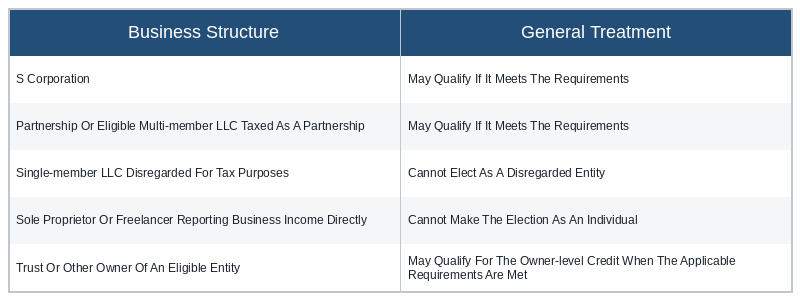
A single-member LLC can still be an owner of an eligible partnership or S corporation through a disregarded entity, where the applicable rules permit. That does not make the single-member LLC itself an eligible electing entity.
The election is made annually on a timely filed original California entity return using Form FTB 3804. It cannot be created through an amended return, and a valid election is irrevocable for that tax year. The entity’s election also binds consenting and nonconsenting owners, although only qualifying consenting owners receive the PTE credit according to California Franchise Tax Board’s PTE elective tax guidance.
Two changes matter for the 2026 decision: the increased federal SALT deduction cap and California’s extension of its PTE election under Senate Bill 132.
For the 2026 tax year, the federal SALT deduction limit is $40,400 for most taxpayers who itemize, or $20,200 for married taxpayers filing separately. The limit begins to phase down when modified adjusted gross income (MAGI) exceeds $505,000, or $252,500 for married taxpayers filing separately. The phase-down is 30% of the excess MAGI, subject to a $10,000 minimum cap for most filing statuses.
For example, a taxpayer with $550,000 of MAGI would have a preliminary cap reduction of $13,500: 30% of the $45,000 excess over $505,000. The resulting limit would be $26,900 before applying the statutory minimum. Actual deduction calculations should follow the current IRS instructions.
The federal cap increase is temporary under current law. It is scheduled to increase by 1% annually through 2029 and revert to $10,000 for most taxpayers in 2030.
California does not simply adopt the federal SALT cap for its own income tax calculations. The federal deduction and California’s entity-level tax and owner credit must be analyzed separately.
The federal cap increase is temporary under current law. It is scheduled to increase by 1% annually through 2029 and revert to $10,000 for most taxpayers in 2030, as outlined in the IRS Publication 505 for 2026.
California does not simply adopt the federal SALT cap for its own income tax calculations. The federal deduction and California’s entity-level tax and owner credit must be analyzed separately under Internal Revenue Code Section 164.
California Senate Bill 132 extended the PTE elective tax and credit to qualifying tax years beginning in 2026 and before January 1, 2031. It also changed the consequences of a missed or insufficient June 15 payment.
For tax years beginning in 2026 through 2030, an eligible entity may still make a valid PTE election even if it misses or underpays the required June 15 payment. However, the owners’ qualifying PTE credits are reduced by 12.5% of each owner’s pro rata share of the unpaid amount that was due on June 15.
This is different from the rule for tax years 2022 through 2025, when failing to make the required June 15 payment prevented the entity from making the election for that year.
The change does not eliminate the payment requirement. It changes the consequence of failing to meet it.
Source: FTB PTE tax frequently asked questions, updated August 4, 2026.
The best way to evaluate the election is to compare the federal deduction that would be available without it against the entity-level deduction that may be available with it. Then account for the California credit, any credit reduction, the owner’s marginal federal tax rate, and other tax effects.
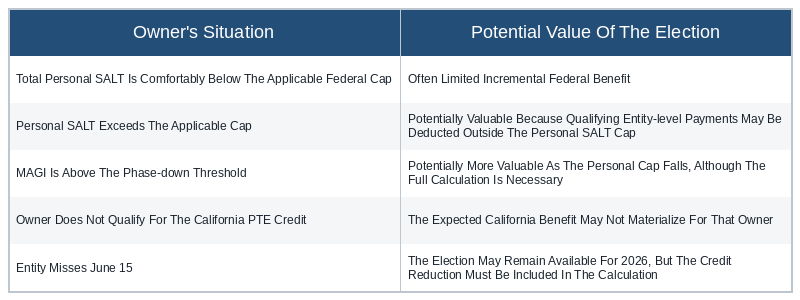
These are screening rules, not a final tax conclusion. The comparison should use the owner’s actual filing status, itemized deductions, tax rates, entity income, and other relevant tax attributes.
Assume a taxpayer has $200,000 of eligible pass-through income, a 9.3% PTE tax of $18,600, and $12,000 of other deductible property taxes. Assume the taxpayer can deduct the full $30,600 of relevant personal SALT without an election.
If the owner is already able to deduct the same $30,600 without the election, shifting the state income tax payment to the entity may create little or no additional federal deduction under these simplified assumptions.
The California credit may still offset the owner’s California income tax, but the entity-level payment does not automatically create a new federal benefit equal to 9.3% of business income.
Assume a taxpayer has $400,000 of QNI, producing a PTE tax of $37,200, and $15,000 of other SALT. Assume the taxpayer’s applicable federal cap is $40,400 and the federal marginal rate is 35%.
Without the election, the simplified personal SALT total is $52,200, but the deductible amount is capped at $40,400. With a qualifying entity-level deduction, the $37,200 payment may be deducted outside that personal cap, while the $15,000 of other SALT remains subject to the personal limitation.
Under these assumptions, the additional deduction is $11,800, producing an estimated federal tax reduction of $4,130 at a 35% marginal rate.
This is an illustrative comparison, not a forecast of actual tax savings. It excludes the QBI deduction, alternative minimum tax, other tax interactions, and California-specific details.
Assume a taxpayer has $700,000 of MAGI, $600,000 of QNI, and $12,000 of other SALT. The PTE tax is $55,800.
At this MAGI, the federal SALT cap is reduced to its $10,000 floor under the 2026 rules. In a simplified comparison, the qualifying entity-level deduction may therefore create a larger additional federal deduction than it would for an owner whose personal SALT remains fully deductible.
However, the result should not be described as automatic savings of $19,530. That figure would represent 35% of the $55,800 PTE payment, not necessarily the final incremental tax benefit after all relevant tax interactions. The QBI deduction and other provisions may change the result.
The practical test: model both options using the actual federal and California returns, rather than assuming that a larger entity-level deduction equals the same amount of tax savings.
The PTE election can help with federal tax deductions, but it introduces trade-offs that should be included in the decision.
A proper comparison should measure the additional federal tax benefit against any reduction in other deductions, the cost of funding the payments earlier, and the time required to coordinate the entity and owners’ returns.
The June 15, 2026, payment date has passed. The remaining steps depend on what the entity paid and whether it intends to make a valid election on its original return.
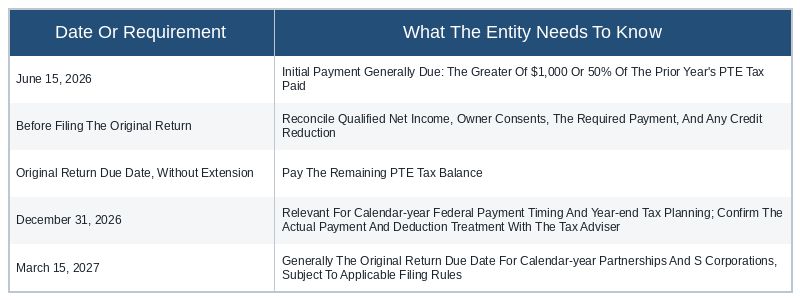
Payments can generally be made through FTB Web Pay, electronic funds withdrawal through supported tax software, or the applicable FTB 3893 payment voucher. Payments must be designated as PTE elective tax payments and kept separate from other tax payments. Follow current FTB instructions for the method used.
For an eligible entity, missing June 15 does not automatically eliminate the 2026 election. Instead, the credit reduction must be calculated for each qualifying owner based on that owner’s share of the required payment that was not made.
FTB provides an example in which the required payment was $23,250 and only $10,000 was paid. The unpaid amount was $13,250. For a consenting owner with a $100,000 share of the entity’s $300,000 QNI, the credit reduction is:
12.5% × 13,250×(100,000 ÷ $300,000) = approximately $552.
The owner’s original $9,300 credit is therefore reduced to approximately $8,748.
The example illustrates why the calculation must use the unpaid required amount and each owner’s share, rather than simply reducing every owner’s credit by 12.5% of the total PTE tax.
Do not assume that paying the shortfall after June 15 removes the statutory credit reduction. FTB states that errors in the June 15 payment must be corrected by that deadline to avoid the reduction. Confirm the entity’s specific position with a California tax professional.
The tax calculation is only one part of the decision. The entity also needs a reliable record of owner consents, qualified net income, PTE tax payments, and the credits reported on owners’ returns.
Bookkeeping helps keep payment records and tax accounts reconciled. Cash-flow forecasting helps the business fund the required payments without disrupting payroll, operating expenses, or other obligations. Tax planning brings these pieces together to compare the election’s likely benefit with its costs.
For a business with multiple owners or fluctuating income, a CPA-led review before filing can help identify whether the election is appropriate and how the payment and credit should be documented.
The California PTE election should not be treated as an automatic tax-saving strategy. Its value depends on how the entity-level federal deduction compares with the no-election alternative, whether the owners can use the California tax credit, and whether the entity meets the applicable payment and filing requirements.
For 2026, the most useful next step is to compare both outcomes using your actual qualified net income, ownership allocations, other deductions, and payment history. A CPA-led review can help determine whether the election supports your business’s overall tax position and cash-flow needs.
NexusWorks LLC is an accounting and advisory practice owned and led by U.S.-licensed CPAs. Our team can help you evaluate the potential federal tax benefit, California credit implications, and compliance requirements before finalizing your PTE election.