
Tax Planning Strategies
California Estimated Tax Payments: 30/40/0/30 Schedule
California splits estimated tax into four installments of 30%, 40%, 0% and 30% of the required annual payment.…
READ MORE ● NexusWorks Team
Reviewed by a licensed CPA
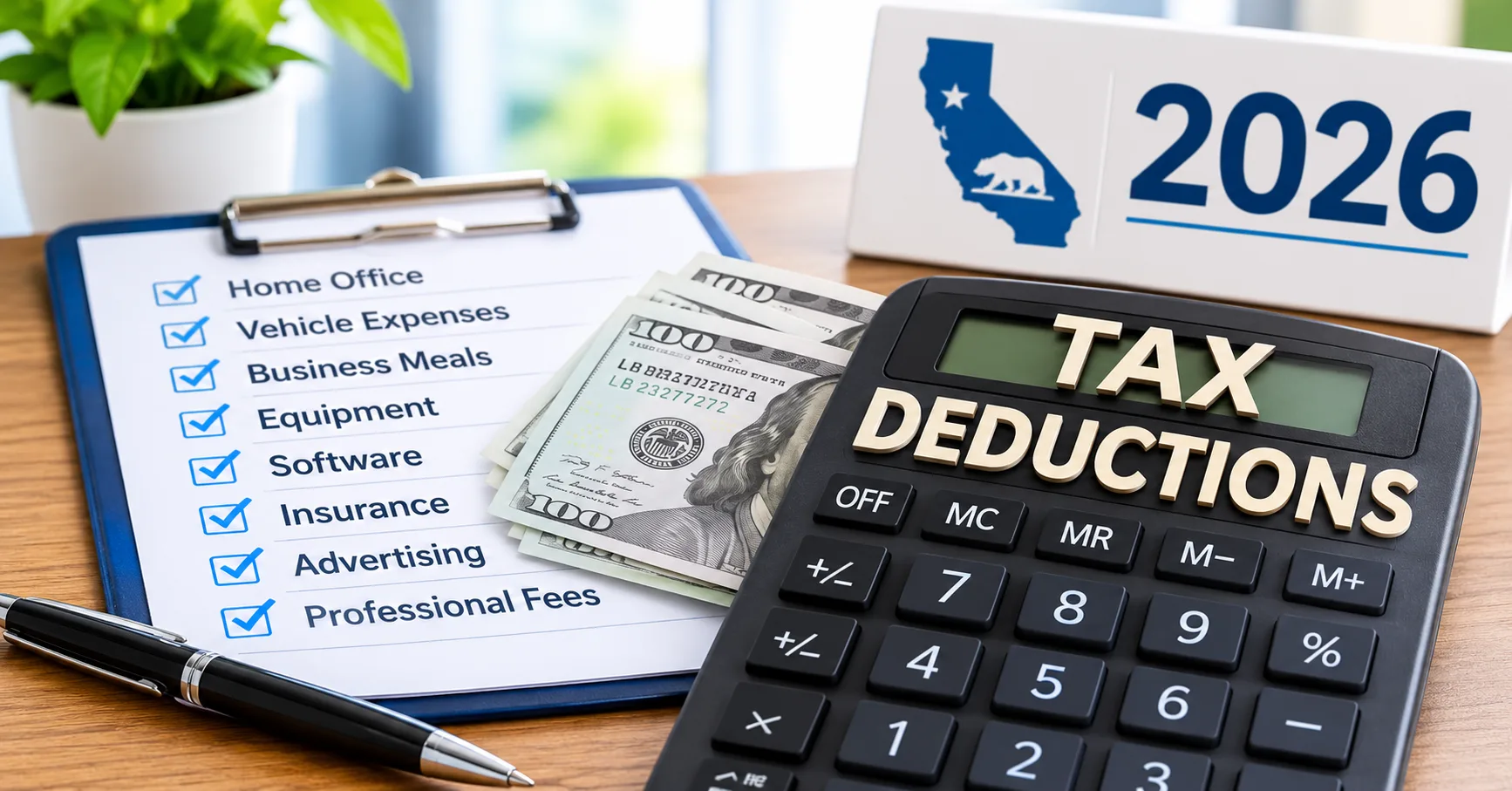
Common small business tax deductions include rent or a home office, vehicle use, equipment, software, insurance, professional fees, advertising, retirement contributions and 50% of qualifying business meals. Each expense has to be ordinary and necessary for your business, and you need records showing what it was, when it happened and why it was for business.
This guide pairs each deduction with its governing rule and the records that support it. Start with the checklist, then read the sections on deductions with special rules. It reflects federal and California rules for 2026. For actions to take before December 31, see our year-end guide.
Most business deductions rest on one rule in Internal Revenue Code §162: the expense must be ordinary and necessary for your trade or business.
Personal expenses are not deductible. Mixed-use expenses, such as a phone used for both business and personal calls, must be divided, and only the business share counts. Some costs must be capitalized and depreciated over several years, and some deductions have their own limits, covered below.
Example 1: A graphic designer pays for design software. The software is common in the industry and useful for the work, so it generally meets the test.
Example 2: The same designer buys a family vacation and calls it a “creative retreat.” Without a real business purpose, it fails the test, whatever it’s called.
The table lists common deductions, the key rule for each and the record that supports it. Use it to check what applies to your business and whether your records are complete.
| Expense | Rule to know | Record to keep |
|---|---|---|
| Space and operations | ||
| Rent for business space | Deductible for space used in the business; prepaid rent generally follows the period it covers. | Lease, invoices and proof of payment. |
| Home office | Space must be used regularly and exclusively for business and meet a qualifying test. | Measurements or floor plan, photos, description of use, home expense records. |
| Utilities (business space) | Deductible for business space; home utilities only as part of the home office. | Bills and proof of payment; allocation method for shared space. |
| Business insurance | Premiums for business coverage are generally deductible; prepaid multi-year policies are spread over the coverage period. | Policy, premium invoices and proof of payment. |
| Vehicle and travel | ||
| Vehicle expenses | Choose the standard mileage rate or actual expenses; only business use counts, and commuting doesn’t. | Contemporaneous mileage log; actual expense records if using that method. |
| Business travel | Must be away from your tax home, generally overnight, and primarily for business. | Itinerary, receipts and business purpose for each day. |
| Parking and tolls | Deductible for business trips, in addition to the standard mileage rate; commuting parking is not. | Receipts or statements tied to the mileage log. |
| Meals and gifts | ||
| Business meals | Generally 50% deductible if not lavish, you or an employee attend, and the meal is with a business contact or during business travel. | Receipt, attendees, business relationship and business purpose. |
| Business gifts | Deduction limited to $25 per recipient per year. | Recipient, business relationship, date, cost and description. |
| Equipment and technology | ||
| Equipment and furniture | Generally depreciated, but Section 179, bonus depreciation or the de minimis safe harbor may allow faster deductions. | Invoice, proof of payment and placed-in-service date. |
| Computers and devices | Same as equipment; business-use percentage matters for mixed-use items. | Invoice, placed-in-service date and business-use records. |
| Software and subscriptions | Subscriptions are generally deducted as paid or incurred; purchased off-the-shelf software is generally depreciated or expensed. | Invoices or account statements and subscription terms. |
| People and services | ||
| Employee wages and benefits | Reasonable pay for services actually performed is deductible. | Payroll records, W-2s and benefit plan documents. |
| Contractor payments | Deductible for business services; Form 1099-NEC may be required. | Invoices, contracts, Form W-9 and 1099 filings. |
| Professional fees (legal, accounting) | Deductible when for the business; some fees tied to buying assets must be capitalized. | Engagement letters and invoices. |
| Retirement plan contributions | Deductible within plan rules and annual limits. | Plan documents and contribution records. |
| Marketing and growth | ||
| Advertising and marketing | Generally deductible when it promotes the business. | Invoices, contracts and samples or screenshots. |
| Website costs | Hosting and maintenance are generally deductible; development costs may need to be capitalized. | Invoices and a description of the work. |
| Business startup costs (first-year businesses) | Up to $5,000 deductible in the first year, reduced when total startup costs exceed $50,000; the rest is amortized over 180 months. | Invoices dated before the business opened, with descriptions. |
| Other | ||
| Business bank and card fees | Deductible for business accounts. | Bank and card statements. |
| Interest on business loans | Deductible when loan proceeds are used for the business; larger businesses may face limits. | Loan documents and interest statements showing use of funds. |
| Licenses and permits | Deductible when required for the business. | Receipts and copies of licenses. |
| Education and training | Deductible when it maintains or improves skills for your current business, not when it qualifies you for a new one. | Receipts, course descriptions and the link to your business. |
| Self-employed health insurance | Available to many self-employed owners, but not for months you were eligible for an employer-subsidized plan. | Policy, premium statements and proof of payment. |
Eligibility depends on your business’s facts, entity type and accounting method, and some deductions have limits or special rules.
Sources: IRS Publication 334, IRS Publication 463, IRS Publication 946, IRC §162. Last reviewed: November 19, 2026.
Want a second look at your deductions and records before you file? Book a year-end strategy session.
Under IRS Publication 587, you can deduct part of your home only if the space is used regularly and exclusively for business. It must also be your principal place of business, a place where you regularly meet clients, or a separate business structure.
Employees generally can’t take the home office deduction. Unreimbursed employee expenses are no longer deductible, and 2025 federal law made that permanent.
There are two methods:
Sole proprietors and single-member LLC owners generally claim it on their own return. S corporation owners usually receive a tax-free reimbursement through an accountable plan, and partnership rules differ again.
Records to keep: measurements or a floor plan, photos of the space, a short description of how it’s used, and, for the regular method, the home expense records behind each amount.
IRS Publication 463 allows two methods for business use of a vehicle:
To use the standard mileage rate for a car you own, you generally must choose it in the car’s first business year; you can switch to actual expenses later, but usually not the reverse. For a leased car, the standard rate, once chosen, applies for the whole lease.
Commuting between your home and a regular workplace is generally not deductible. For a mixed-use vehicle, divide business miles by total miles to find your business-use percentage.
Annual depreciation limits apply to many vehicles, and heavier vehicles follow different rules, so check Publication 946 before claiming large first-year depreciation.
Records to keep: a mileage log recorded at or near the time of each trip, showing date, destination, business purpose and miles, plus receipts if you use actual expenses. A log reconstructed months later is weaker evidence.
Business meals are generally 50% deductible when the meal isn’t lavish, you or an employee is present, and the meal is with a business contact, such as a client, customer or consultant, or is eaten during business travel.
Entertainment is generally not deductible. That includes event tickets, golf, concerts and similar activities, even with a client.
Some meals can be 100% deductible, such as food for a company-wide holiday party or meals treated as taxable employee compensation.
Starting in 2026, most meals an employer provides for its own convenience, such as food at an on-site eating facility, are no longer deductible, with limited exceptions, including for restaurants feeding their own employees.
Records to keep: receipt, names of attendees, business relationship and business purpose.
Travel expenses are deductible when you’re away from your tax home (generally the city where your main place of business is), long enough to need sleep or rest, and the trip is primarily for business. Deductible costs can include airfare, lodging, ground transportation and 50% of meals. Mixed business-and-personal trips need careful allocation.
Records to keep: itinerary, receipts and the business purpose of each day.
Deductions for business gifts are limited to $25 per recipient per year. Incidental costs, such as engraving, packaging or shipping, don’t count toward the limit. Items costing $4 or less with your business name permanently imprinted and distributed widely, such as pens, aren’t treated as gifts.
Records to keep: recipient, business relationship, date, cost and description of the gift.
Equipment, furniture and vehicles are generally depreciated, meaning the cost is deducted over the asset’s useful life. Several rules can speed that up:
The date an asset is placed in service, meaning ready and available for use in the business, determines the tax year of the deduction, not the purchase date.
California note: California does not conform to federal bonus depreciation, and its Section 179 limit is $25,000, reduced once qualifying purchases exceed $200,000. See the FTB’s instructions for Form FTB 3885A.
Buy equipment because the business needs it, not for the deduction alone. See IRS Publication 946.
Retirement plan and entity choices are planning questions; our guide to tax planning vs. tax preparation explains how those decisions differ from recording deductions.
A strong record shows:
A bank or card statement proves payment but not what you bought; an itemized receipt or invoice shows what was purchased. For meals, travel and mixed-use items especially, you need both, plus a note of the business purpose.
Good practices:
The IRS recordkeeping guidance and IRS Publication 583 cover what to keep.
Want help checking that your records support your deductions? Book a year-end strategy session.
The IRS generally recommends keeping records for three years from the date you filed the return. Longer periods apply in some cases: six years if income was underreported by more than 25%, seven years for a bad debt or worthless securities deduction, and at least four years for employment tax records. Keep records for assets until the period of limitations expires for the year you sell or dispose of them. See the IRS guidance on how long to keep records.
California’s general period for assessing additional tax is four years, longer than the federal three years, so many California businesses keep records for at least four years.
Many California businesses keep separate federal and California depreciation schedules for the same assets.
NexusWorks is led by California-licensed CPAs. Through our tax planning and strategy, tax filing and compliance and bookkeeping services, a business owner can generally expect support with:
We confirm scope before work begins and can’t promise a particular outcome. Learn more about our small business CPA services.
A preparation aid to organize the records behind your deductions. Not every deduction applies to every business.
☐ Space and operations: lease, home office measurements and photos, utility bills, insurance policies
☐ Vehicle: mileage log (date, destination, business purpose, miles) and actual expense receipts
☐ Meals and travel: receipts with attendees, business relationship and purpose; itineraries
☐ Gifts: recipient, relationship, date, cost and description
☐ Equipment: invoices and placed-in-service dates (federal and California)
☐ People and services: payroll records, W-9s, 1099s, engagement letters
☐ Marketing: invoices and samples
☐ Other: loan statements, licenses, training receipts, health insurance statements
☐ Notes and responsible person: ______________________
A small business can generally deduct ordinary and necessary expenses, such as rent or a qualifying home office, vehicle use, equipment, software, insurance, professional fees, advertising, wages, retirement contributions and 50% of qualifying business meals. Personal expenses aren’t deductible, and some costs must be depreciated.
An ordinary expense is common and accepted in your trade or industry. A necessary expense is helpful and appropriate for your business, though it doesn’t have to be indispensable. Both tests come from Internal Revenue Code §162, and an expense generally must meet both to be deductible as a business expense.
You may qualify if part of your home is used regularly and exclusively for business and is your principal place of business, a place where you meet clients, or a separate business structure. Employees generally can’t claim it. Sole proprietors claim it directly, while S corporation owners usually use an accountable plan.
It depends on your vehicle’s costs and business mileage. The standard mileage rate is simpler, at 72.5 cents per mile for 2026, while actual expenses may be higher for costly vehicles. For a car you own, choose the standard rate in the first business year if you want to keep that option later.
Most business meals are 50% deductible when they aren’t lavish, you or an employee is present, and the meal is with a business contact or during business travel. Limited exceptions allow 100%, such as company-wide holiday parties. Starting in 2026, most meals employers provide for their own convenience aren’t deductible.
No. Entertainment, such as event tickets, golf outings and concerts, is generally not deductible, even when a client attends and business is discussed. Food bought separately at such an event and listed on its own receipt may still qualify for the 50% meals deduction.
You need records that show what each expense was, when it happened, how much you paid, who you paid and why it was for business. A bank statement alone usually shows only payment. Meals, travel, gifts and vehicle use have stricter documentation rules, so keep itemized receipts and business-purpose notes.
Keep most records for at least three years after filing your federal return, longer in some cases, such as four years for employment tax records. In California, the general assessment period is four years, so many California businesses keep records at least that long. Keep asset records until you sell or dispose of the asset.
A deduction is only as good as the record behind it. If an expense is ordinary and necessary and you can show what it was, when it happened and why it was for business, you’re on solid ground. Where special rules apply, a second look is worth it.
Want a second look at your deductions and records before you file? Book a year-end strategy session.
You can also contact NexusWorks to discuss your situation.
Keep reading
Tax Planning Strategies
California splits estimated tax into four installments of 30%, 40%, 0% and 30% of the required annual payment.…
READ MORE ●Tax Planning Strategies
AI tax preparation tools handle data entry and standard situations well, such as W-2 income and common credits.…
READ MORE ●Tax Planning Strategies
A W-2 gives you fewer levers than a business owner has, but the ones you have still matter.…
READ MORE ●Hi there! Have a question about tax, bookkeeping or CFO support? Send us a message on WhatsApp.
Start chat