
Tax Planning Strategies
AI Tax Preparation vs a CPA (2026): Where Software Breaks
AI tax preparation tools handle data entry and standard situations well, such as W-2 income and common credits.…
READ MORE ● NexusWorks Team
Reviewed by a licensed CPA
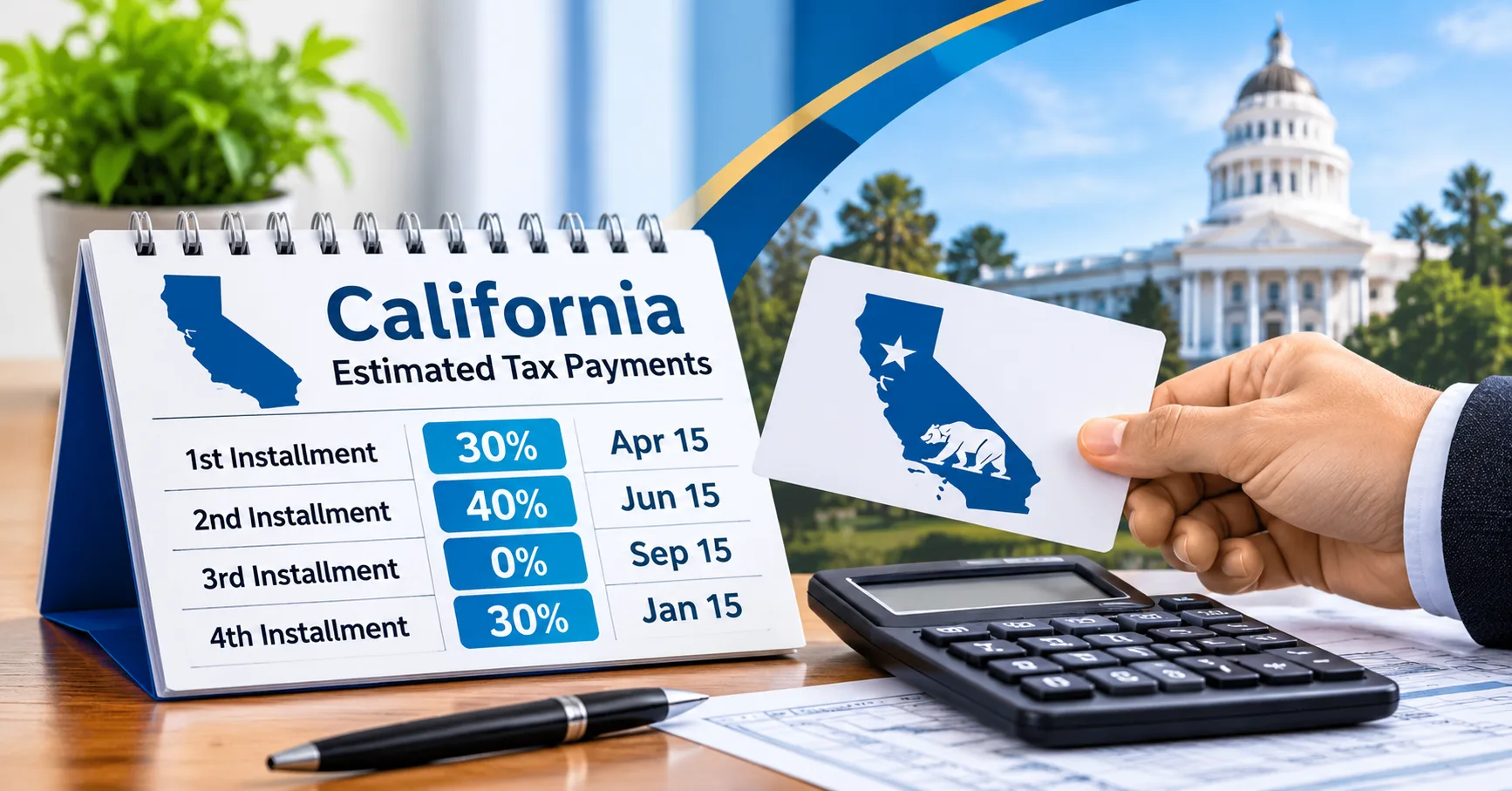
California splits estimated tax into four installments of 30%, 40%, 0% and 30% of the required annual payment. Payments are due April 15 and June 15, nothing is due September 15, and the final 30% is due January 15. Because the federal schedule uses four equal 25% payments, many business owners underpay California in the first half of the year and are surprised by the January installment. Payments are made with Form 540-ES or FTB Web Pay.
The last installment for the 2026 tax year is due January 15, 2027. This guide to California estimated tax payments covers the schedule and dates for 2026 and 2027, how it compares with the federal schedule, who has to pay, the safe-harbor rules (including California’s high-income exception), how to pay and what happens if you underpay.
California law sets four installments for individuals who pay estimated tax:
Each percentage is a share of your required annual payment, the amount you need to pay during the year to avoid an underpayment penalty. It is not a percentage of your income or your total tax. Because of the schedule, 70% of the required annual payment is due by June 15.
When a due date falls on a weekend or holiday, the payment is generally due the next business day. Confirm the 2027 dates in the FTB’s 2027 Form 540-ES instructions once they are published. Fiscal-year taxpayers follow the same rules, based on their own tax year.
The federal schedule splits the required annual payment evenly. California’s doesn’t. Here is how the two lineup for the 2026 tax year.
| Installment | Federal % & date | California % & date |
|---|---|---|
| Q1 | 25%, April 15, 2026 | 30%, April 15, 2026 |
| Q2 | 25%, June 15, 2026 | 40%, June 15, 2026 |
| Q3 | 25%, September 15, 2026 | 0%, September 15, 2026 (no payment) |
| Q4 | 25%, January 15, 2027 | 30%, January 15, 2027 |
Percentages are of the required annual payment, and amounts depend on your income, withholding and the safe-harbor method you use.
Sources: IRS Form 1040-ES, FTB 2026 Form 540-ES instructions. Last reviewed: November 23, 2026.
Not sure your California estimates are on track before January 15? Schedule an estimated tax review.
California’s January installment is 30% of the required annual payment, compared with 25% federally. If your federal and California required payments were the same size, your January California payment would be one-fifth larger than your January federal payment. Because September is 0%, January is also your first California payment since June, so a seven-month gap ends with the second-largest installment of the year.
Illustrative example: Suppose your required California annual payment is $20,000 and you pay $5,000 each quarter, the federal pattern.
Even though you pay the full $20,000 by January, the shortfall from April through September can still trigger an underpayment penalty for those periods. California calculates the penalty separately for each installment period, so catching up later doesn’t erase an earlier underpayment.
You generally must make California estimated payments if you expect to owe at least $500 ($250 if married/RDP filing separately) after withholding and credits, and your withholding won’t cover the smaller of the safe-harbor amounts described below. The federal threshold is $1,000.
Common situations include:
Not everyone needs to make estimated payments. If your withholding covers your tax, or the safe harbor, you may owe nothing extra during the year.
Some people can increase withholding instead of making estimated payments. An S corporation owner on payroll, for example, can raise California withholding on Form DE 4 or federal withholding on Form W-4.
For federal purposes, withholding is generally treated as paid evenly throughout the year, unless you elect otherwise. That means extra withholding late in the year can help cover earlier installment periods. California’s Form 5805 instructions, available on the FTB forms page, explain how withholding is credited across its uneven installments, so confirm the California treatment before relying on late-year withholding.
Corporations, LLCs and pass-through entity elective tax payments have their own estimated rules and forms. For example, LLCs estimate the annual LLC fee on FTB 3536; our guide to California LLC taxes covers that form. This article covers individual estimates on Form 540-ES.
A safe harbor is a payment level that protects you from an underpayment penalty, even if you still owe tax when you file.
You generally avoid a federal penalty if your withholding and timely estimated payments equal at least the smaller of:
California uses the same structure:
The difference is timing: the California safe-harbor amount is paid in the 30/40/0/30 pattern.
If your California AGI for the current year is $1,000,000 or more ($500,000 if married/RDP filing separately), you generally cannot use the prior-year safe harbor. Your required payments must be based on the current year’s tax.
The federal rules don’t have this exception. That makes an accurate current-year projection especially important for high earners with large bonuses, equity compensation or capital gains, because a prior-year figure won’t protect them in California.
If your income arrives unevenly during the year, such as a large capital gain in the fourth quarter, the annualized income installment method may reduce or eliminate a penalty. It matches each required installment to the income you actually earned up to that point. California uses FTB Form 5805, and the federal equivalent is IRS Form 2210.
Projection-based planning is the best way to set estimates in a year with uneven income. Our guide to tax planning vs. tax preparation explains how that kind of planning works.
Want help choosing a safe-harbor approach for California and federal estimates? Schedule an estimated tax review.
The FTB offers several ways to pay California estimated tax. See the FTB’s payment options for current details.
To make sure each payment is applied correctly, choose “estimated tax payment” and the right tax year. The January 15, 2027 payment belongs to the 2026 tax year, not 2027. On a check, write your SSN or ITIN and “2026 Form 540-ES.”
California requires individuals to pay electronically once they make an estimated or extension payment over $20,000, or file an original return with a total tax liability over $80,000. After you meet either threshold, all future payments must be made electronically, and a penalty may apply if you pay another way. You can request a waiver from the FTB in some circumstances.
For federal estimates, use IRS Direct Pay or the Form 1040-ES vouchers. The IRS estimated tax guidance covers federal rules.
If you don’t pay enough by an installment due date, an underpayment penalty may apply for that installment period. The penalty is based on the amount you were short and how long it stayed unpaid, so it works much like interest.
Catching up later in the year reduces the penalty going forward but doesn’t erase it for earlier periods. In limited circumstances, such as a casualty, disaster or other unusual circumstances, or retirement or disability in some cases, the penalty may be waived.
FTB Form 5805 is used to calculate the California penalty, apply the annualized income method or claim an exception. If you receive a penalty notice, compare it with your payment records before responding.
NexusWorks is led by California-licensed CPAs. Our tax planning and strategy services include tax projections and estimated tax payment setup. A taxpayer working with a CPA on estimates can generally expect help with:
We confirm scope before work begins and can’t promise a particular outcome. Business owners can also learn about our small business CPA and tax filing and compliance services.
Use this calendar to track both schedules in one place. Amounts depend on your situation.
| Installment | Federal | California | Amount paid | Date paid | Confirmation # |
|---|---|---|---|---|---|
| 2026 Q1 | 25%, Apr 15, 2026 | 30%, Apr 15, 2026 | |||
| 2026 Q2 | 25%, Jun 15, 2026 | 40%, Jun 15, 2026 | |||
| 2026 Q3 | 25%, Sep 15, 2026 | 0%, no payment | |||
| 2026 Q4 | 25%, Jan 15, 2027 | 30%, Jan 15, 2027 | |||
| 2027 Q1 | 25%, Apr 15, 2027 | 30%, Apr 15, 2027 | |||
| 2027 Q2 | 25%, Jun 15, 2027 | 40%, Jun 15, 2027 | |||
| 2027 Q3 | 25%, Sep 15, 2027 | 0%, no payment | |||
| 2027 Q4 | 25%, Jan 18, 2028 | 30%, Jan 18, 2028 |
☐ Required annual payment (federal): ____________ (California): ____________
☐ Safe-harbor method used: ____________
☐ Withholding notes: ____________
For the 2026 tax year, California estimated payments are due April 15, 2026 (30%), June 15, 2026 (40%) and January 15, 2027 (30%). September 15, 2026 is a 0% installment, so no California payment is required then. Dates shift to the next business day when they fall on a weekend or holiday.
California law sets uneven installments that collect 70% of the required annual payment by June 15. The practical effect is that the state receives the most estimated tax in the first half of the year. The schedule applies to individuals filing Form 540-ES, regardless of how the federal schedule works.
No. The third California installment is 0%, so no California estimated payment is required on September 15. Your federal estimated payment is still due that day if you make federal estimates. Some people choose to pay California early anyway, which is allowed but not required.
California’s fourth installment is 30% of the required annual payment, while the federal fourth installment is 25%. Because September is 0%, January is also the first California payment since June. The percentages apply to each system’s own required annual payment, so the dollar amounts differ.
You generally must pay if you expect to owe at least $500 ($250 married/RDP filing separately) after withholding and credits. This often includes self-employed people, S corporation and partnership owners, investors, rental owners and employees whose bonus or RSU withholding falls short. Not everyone needs to pay estimates.
Not if California AGI for the current year is $1,000,000 or more ($500,000 married/RDP filing separately). Those taxpayers must base estimated payments on the current year’s tax. Federal rules have no such exception, so high earners may need separate federal and California payment strategies.
Use FTB Web Pay to pay from a bank account at no charge, choosing “estimated tax payment” and the correct tax year. You can also pay by credit card through a provider that charges a fee. If you meet the mandatory e-pay thresholds, you must pay electronically.
An underpayment penalty may apply for that installment period, based on the amount you were short and how long it stayed unpaid. Paying as soon as possible limits the penalty going forward. FTB Form 5805 calculates the penalty and lists exceptions and waivers that may apply.
California’s 30/40/0/30 schedule is easy to follow once you know it’s different from the federal one. The key points: 70% is due by June 15, nothing is due in September, and the last 30% is due in January. If your income is high or uneven, base your estimates on a current-year projection.
Not sure your California estimates are on track before January 15? Schedule an estimated tax review.
You can also contact NexusWorks to discuss your situation.
Keep reading
Tax Planning Strategies
AI tax preparation tools handle data entry and standard situations well, such as W-2 income and common credits.…
READ MORE ●Tax Planning Strategies
A W-2 gives you fewer levers than a business owner has, but the ones you have still matter.…
READ MORE ●Tax Planning Strategies
Wyoming is usually the best state for a non-US founder running an online business from abroad. Compare Wyoming,…
READ MORE ●Hi there! Have a question about tax, bookkeeping or CFO support? Send us a message on WhatsApp.
Start chat