
Tax Planning Strategies
Best State to Form an LLC as a Non-US Resident
Wyoming is usually the best state for a non-US founder running an online business from abroad. Compare Wyoming,…
READ MORE ● NexusWorks Team
Reviewed by a licensed CPA
Short answer: Compare fractional CFO vs. full-time CFO costs, responsibilities and benefits. Learn when each option makes financial sense for your business.
Written by: Content Team
Reviewed by: Hassan Rathore, CPA (Ex-PwC), Founder of NexusWorksLLC
Last reviewed: November 5, 2026
A business can reach a point where its accounting reports are accurate, but management still lacks the financial insight needed to make confident decisions. Owners may understand what they earned last month but struggle to forecast cash requirements, evaluate expansion plans or determine whether rising revenue is actually improving profitability.
That is when hiring a Chief Financial Officer (CFO) becomes a serious consideration. The next decision is whether to employ a full-time executive or engage a fractional CFO.
In the fractional CFO vs. full-time CFO comparison, neither arrangement is automatically better. A fractional CFO provides senior financial guidance for an agreed number of hours, while a full-time CFO takes ongoing responsibility for the company’s financial direction. The right choice depends on how much CFO-level work the business needs, how complex its financial operations have become and whether it requires daily executive involvement.
This guide compares their responsibilities, costs and working arrangements, including a practical calculation to help determine when a full-time hire may become more economical.
A fractional CFO works with a business on a part-time, ongoing or project-based arrangement. A full-time CFO is a permanent executive who dedicates their working time to one organization.
Both can oversee financial planning, forecasting, budgeting, cash flow strategy and business performance. The main difference is how much time and organizational responsibility the company requires.
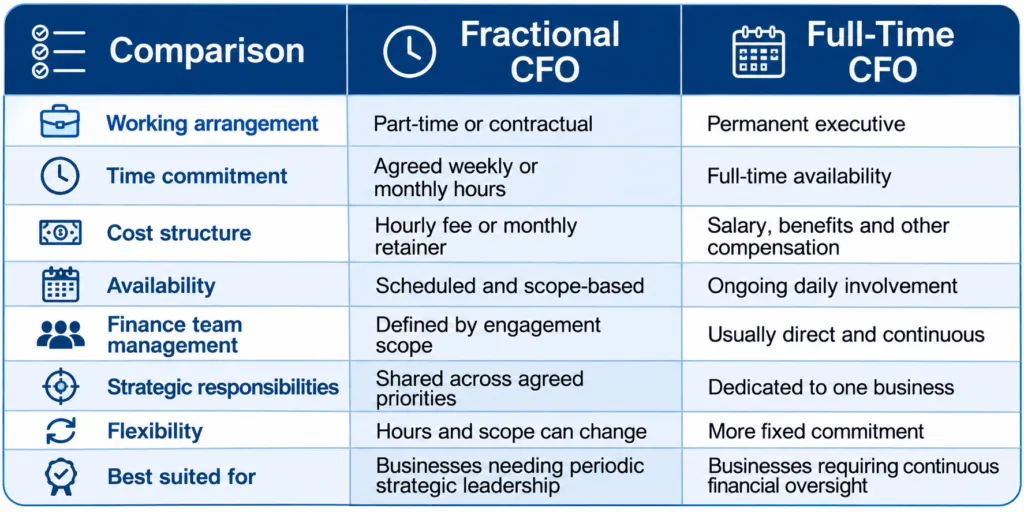
A fractional CFO is not necessarily less experienced than a full-time CFO. The distinction is the working arrangement, not the seniority of the professional.
A fractional CFO performs senior-level financial work without occupying a permanent full-time position. Depending on the engagement, responsibilities can include:
The exact responsibilities should be documented before the engagement begins. A business paying for strategic CFO support should know whether the professional will also manage the finance team, oversee the month-end close or simply review financial performance. Besides this, NexusWorks LLC provides CPA-led fractional CFO advisory, including financial forecasting, budgeting, cash flow management, financial reporting, and growth planning. By connecting bookkeeping, tax strategy, and CFO advisory, NexusWorks helps business owners understand their financial position, identify potential risks, and plan for sustainable growth. Explore NexusWorks LLC’s Fractional CFO Services to understand how integrated bookkeeping, tax strategy, and CFO advisory can support business decisions.
A full-time CFO generally has broader and more continuous responsibility for the company’s financial operations and strategy.
Alongside forecasting and financial planning, the role may involve managing finance employees, overseeing internal controls, coordinating financial reporting across business units and advising the CEO or board on major decisions.
This level of involvement becomes valuable when financial questions arise throughout the working day, rather than at scheduled monthly or quarterly reviews.
Fractional CFO pricing usually depends on hourly rates, the number of hours required, the professional’s experience and the complexity of the work.
Go Fractional’s November 4, 2026 benchmark reports an average observed fractional CFO rate of $179 per hour, with the middle 50% of observed rates between $125 and $225 per hour. Its typical engagement is approximately 14 hours per week. These figures are based on job postings and candidate profiles, not a census of all fractional CFO engagements.
Using that benchmark:
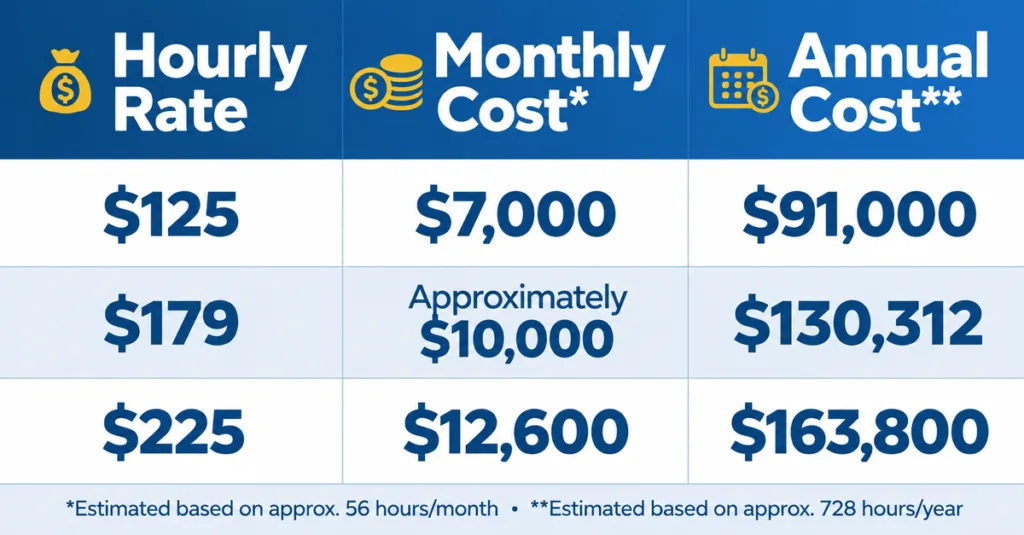
Monthly estimates use 14 hours per week and a four-week billing month. Annual estimates use 14 hours per week for 52 weeks.
The difference between the monthly and annual calculations matters. Multiplying a four-week monthly retainer by 12 produces only 48 weeks of fees. The annual figures above use 52 weeks to make the time assumption clear.
A business requiring only a few hours of monthly financial review may pay less. A company needing extensive cash flow modeling, fundraising preparation or multi-entity financial oversight may require a larger engagement.
Before comparing proposals, ask what the retainer includes, how additional hours are billed and whether meetings, reporting, implementation and urgent support are part of the agreed scope.
A full-time CFO’s compensation varies with company size, industry, location, experience and executive responsibilities. Salary is only one part of the employer’s total cost.
The U.S. Bureau of Labor Statistics reported a May 2025 median annual wage of $166,570 for financial managers. This is a broad occupational category, not a CFO-specific salary.
The BLS also reported that wages represented 70.1% of private-industry employer compensation in December 2025, while benefits represented 29.9%. Applying that broad ratio to the financial-manager median produces an illustrative loaded annual cost of approximately $237,600.
This is a planning proxy, not a published average CFO package. Actual CFO compensation can be higher. For example, Built In’s 2026 U.S. CFO salary data reports average base pay of $229,069 and average total compensation of $314,782, based on anonymous employee-reported data. Its methodology and respondent mix differ from the BLS figures.
A permanent CFO’s cost may also include:
The exact package depends on the employment arrangement. A fractional engagement should not automatically be treated as an independent-contractor relationship for tax purposes: the IRS determines worker status from the actual relationship, including behavioral control, financial control and the relationship of the parties.
The following comparison uses the fractional CFO rate benchmark and the BLS-based loaded compensation estimate.
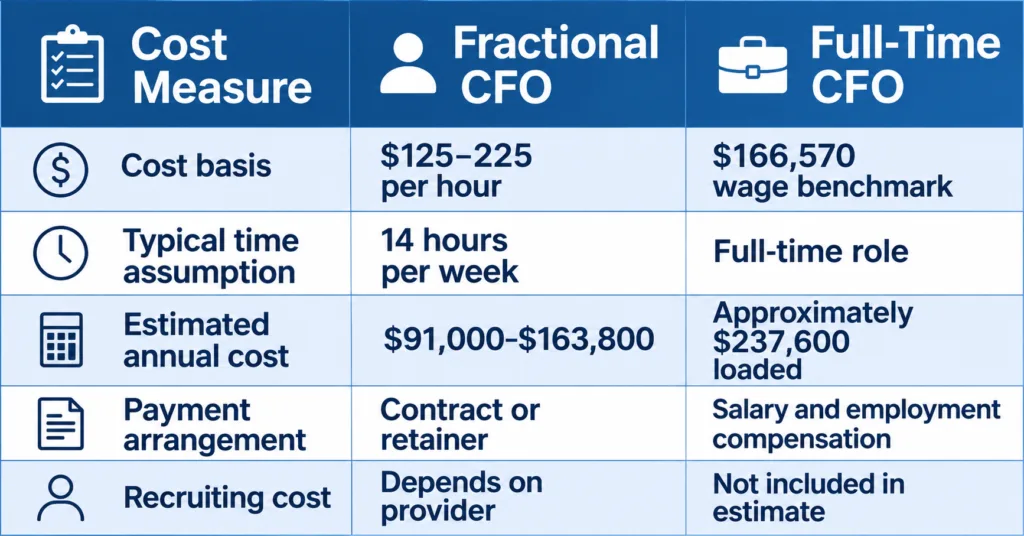
At the average fractional rate of $179 per hour, 14 hours of support per week costs approximately $130,312 annually. That is about 45% below the illustrative $237,600 full-time employment-cost proxy.
This does not mean fractional CFOs charge less for each hour of work. In fact, their hourly rates can be higher than the effective hourly cost of a salaried executive. The difference is that the business purchases fewer hours and avoids maintaining a permanent executive position.
The comparison also does not assume that 14 hours of fractional support delivers the same availability or operational coverage as a full-time CFO.
A fractional CFO is generally a practical choice when a business needs strategic financial guidance but does not require a dedicated executive every working day.
Consider this arrangement when:
For example, a growing professional services business may need monthly profitability reviews, quarterly forecasts and financial guidance before hiring additional staff. A fractional CFO can support those priorities without requiring a permanent executive appointment.
A full-time CFO becomes more appropriate when financial leadership is a continuous operational requirement.
This may be the case when a company:
Revenue can provide context, but it should not be treated as a universal hiring threshold. A business with complex international operations and multiple entities may need more financial oversight than a larger company with a simpler operating structure.
The better question is whether the workload requires continuous executive ownership, not whether the business has crossed an arbitrary revenue figure.
A break-even calculation can help business owners understand when the cost of fractional support starts approaching the cost of a permanent executive.
Using the illustrative figures in this article:
The calculation is:
$237,600 ÷ $179 = approximately 1,328 hours per year.
That equals approximately 25.5 hours per week over 52 weeks.
Under these assumptions, fractional support at the average hourly rate would approach the estimated full-time employment cost if the business consistently required around 25.5 hours of CFO work each week.
This is a cost comparison, not a universal hiring rule. The full-time estimate uses a broad BLS occupational benchmark, not a CFO-specific salary, and the calculation does not account for differences in availability, responsibilities or recruitment costs.
It does, however, provide a useful signal: when a business regularly needs substantial weekly CFO involvement, it should compare the total cost and value of a permanent hire rather than automatically increasing a fractional retainer.
Not every business that needs better financial management needs a CFO immediately. The right role depends on what is missing from the finance function.
A CFO depends on reliable financial information. If bookkeeping is incomplete or financial reports are inconsistent, strategic recommendations may be built on unreliable figures.
In that situation, improving the accounting foundation or adding controller-level oversight may be the more appropriate first step. Paying CFO rates to correct routine bookkeeping problems is not an efficient use of executive expertise.
Yes. A business can begin with fractional financial leadership and move to a permanent CFO position as its requirements develop.
A practical transition may involve four stages:
This approach allows a company to build its financial function before taking on a permanent executive commitment. It also helps define the responsibilities and expectations of the eventual full-time position.
Before signing an agreement, evaluate more than the hourly rate. Ask prospective providers:
A written scope should identify responsibilities, reporting frequency, decision-making authority and the process for changing the engagement. Clear expectations help prevent a mismatch between what the business needs and what the provider actually delivers.
The choice between a fractional CFO and a full-time CFO should reflect the amount of financial leadership your business actually needs. A fractional CFO can provide strategic guidance without a permanent executive commitment when the workload is limited and clearly defined. A full-time CFO is more suitable when financial complexity, team management and ongoing decisions require dedicated executive attention.
Before making the decision, assess the quality of your accounting records, the level of strategic support required and the number of hours your business needs each week.
NexusWorks LLC is an accounting and advisory practice owned and led by U.S.-licensed CPAs. Its integrated approach connects bookkeeping, tax strategy and fractional CFO advisory, helping businesses use reliable financial information for planning and decision-making.
If you are unsure whether your business needs a fractional CFO, a full-time executive or stronger accounting support first, begin by evaluating your reporting quality, cash flow requirements and financial management responsibilities.

Is a Fractional CFO Worth It?
Yes, a fractional CFO can be worth the investment when a business needs strategic financial guidance but does not require a full-time executive. They can help with cash flow forecasting, budgeting, profitability analysis, and growth planning. As discussed in this Reddit conversation about the value of fractional CFO services, the value depends on clear responsibilities, reliable financial data, and measurable business needs.
What Is the Difference Between a CFO and a Fractional CFO?
A CFO is a senior financial executive responsible for a company’s financial strategy, reporting, and long-term financial health. A full-time CFO works within one organization, while a fractional CFO provides strategic financial leadership on a part-time or contract basis, often supporting multiple businesses. The main differences are availability, engagement structure, and cost.
The U.S. Bureau of Labor Statistics’ overview of financial manager responsibilities provides additional context on financial leadership duties.
How Much Does a Fractional CFO Cost?
A fractional CFO’s cost depends on experience, working hours, business complexity, and engagement scope. Pricing may be hourly, monthly, or project-based. According to Go Fractional’s November 2026 CFO rate benchmark, the average observed rate is $179 per hour, with the middle 50% ranging from $125 to $225 per hour.
Is a Fractional CFO as Effective as a Full-Time CFO?
A fractional CFO can provide effective financial leadership when the company’s needs fit the agreed responsibilities and working hours. A full-time CFO offers greater daily availability and continuous involvement in company operations. Effectiveness depends on the business’s financial complexity, the professional’s experience, and the engagement’s scope.
How Many Hours a Week Does a Fractional CFO Work?
A fractional CFO’s weekly hours depend on the company’s financial requirements and engagement scope. Go Fractional’s November 2026 benchmark reports approximately 14 hours per week as a typical engagement. Businesses with more complex reporting, forecasting, or fundraising needs may require additional hours.
Can a Fractional CFO Help With Fundraising?
Yes, a fractional CFO can help businesses prepare for fundraising by developing financial projections, evaluating capital requirements, building financial models, and organizing information for investors or lenders. Their support can improve financial preparation and planning, but it cannot guarantee funding or investment approval.
What Is the Difference Between a Fractional CFO and an Interim CFO?
A fractional CFO generally provides ongoing part-time financial leadership, often supporting multiple businesses. An interim CFO temporarily fills a senior financial leadership position during a vacancy, restructuring, or transition. Fractional arrangements are usually recurring, while interim engagements are typically temporary and may involve full-time responsibilities.
What Do Business Owners on Reddit Say About Fractional CFO Services?
Business owners discussing fractional CFO services on Reddit raise questions about whether strategic advice justifies the cost, how much attention a part-time CFO can provide, and whether the company’s bookkeeping is reliable enough to support financial decisions. These discussions highlight the importance of clear deliverables and realistic expectations. Read the Reddit discussion about fractional CFO costs and value.
Keep reading
Tax Planning Strategies
Wyoming is usually the best state for a non-US founder running an online business from abroad. Compare Wyoming,…
READ MORE ●Tax Planning Strategies
An LLC taxed as an S corp in California usually pays off once profit passes about $80,000 to…
READ MORE ●Tax Planning Strategies
Tax preparation reports the year; tax planning shapes it. See which decisions must happen before December 31 and…
READ MORE ●Hi there! Have a question about tax, bookkeeping or CFO support? Send us a message on WhatsApp.
Start chat