
Business
QuickBooks Payroll Setup Checklist
Before the first QuickBooks payroll, open your state withholding and unemployment accounts, collect W-4s and state forms, set…
READ MORE ● NexusWorks Team
Reviewed by a licensed CPA
Short answer: How white-label bookkeeping works for CPA firms, what it costs, and the Section 7216 and data security rules to check before you outsource.
Short answer: white-label bookkeeping means an outside team keeps your clients’ books under your firm’s name, in your software and to your standards, while your clients deal only with you. CPA firms use it to take on more clients without hiring, to clear busy season backlogs and to hand off cleanup projects. Pricing is usually per client per month, per hour or per dedicated staff member. The two things to check before signing are the review process and how the provider handles taxpayer data.
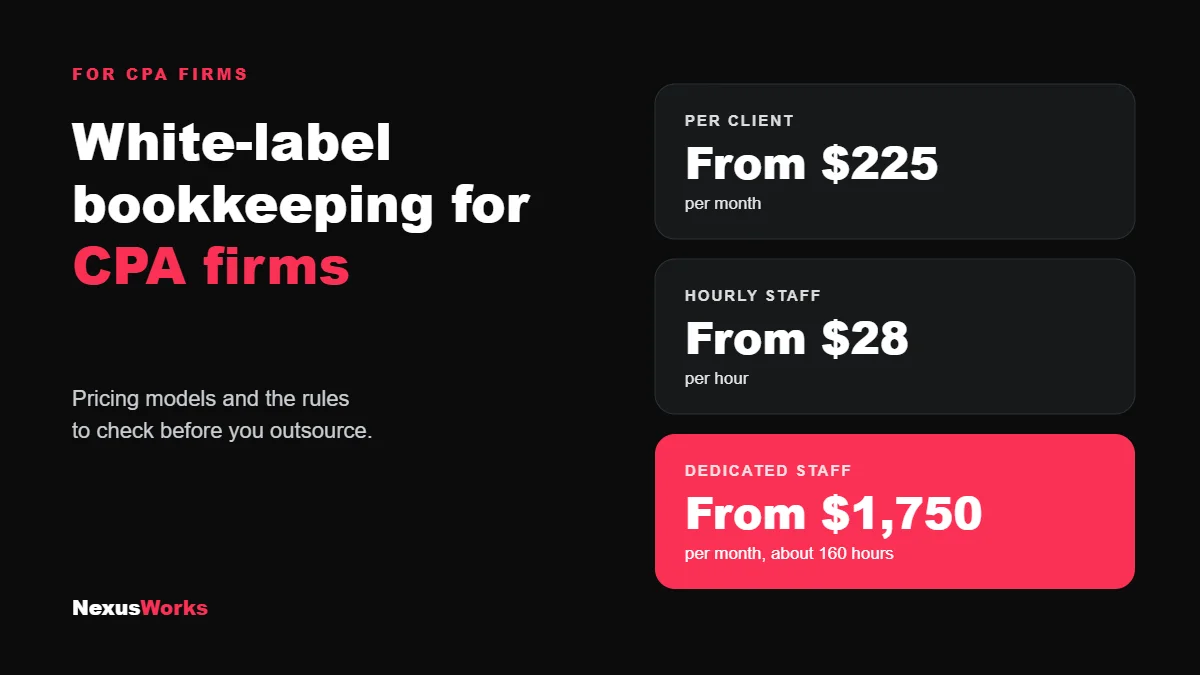
There are three common pricing models. These are NexusWorks’ starting partner rates. Complex engagements are quoted before work starts.
| Model | How it’s priced | Starting rate | Best for |
|---|---|---|---|
| Per client | Monthly fee by transaction volume | $225 a month up to 100 transactions, $395 up to 400, from $650 above that | Recurring monthly bookkeeping |
| Hourly | By staff level | $28 staff, $38 senior, $95 CPA review | Cleanup, catch-up and overflow |
| Dedicated staff | About 160 hours a month per person | $1,750 staff accountant, $2,600 senior or tax preparer, $3,900 reviewer | Firms with steady volume that want a named team |
Compare that with the full cost of a US hire, including salary, payroll taxes, benefits, software seats, training time and recruiting. For many small firms, a dedicated outside accountant costs a fraction of a local staff accountant.
If the outsourced work involves tax return information, federal rules on disclosure apply. According to the IRS Section 7216 FAQs, sharing information with another preparer generally doesn’t need the taxpayer’s consent, but it does if that preparer is outside the United States. In that case the taxpayer must sign a consent with specific required wording. Social Security numbers generally have to be redacted before information goes abroad, unless the taxpayer consents and both firms keep adequate data safeguards.
In practice, that means: get signed consents before sending any tax work offshore, mask SSNs in documents by default, and keep the consents on file.
Tax and accounting firms are expected to keep a written information security plan under the FTC Safeguards Rule. IRS Publication 4557, Safeguarding Taxpayer Data, explains what it should cover. Your plan should describe how any outsourcing partner accesses client data, and you should ask to see the partner’s own security controls.
Many firms add a short clause to engagement letters saying they may use third-party service providers, including providers outside the US, under confidentiality agreements. Check your state board’s rules and your professional liability insurer’s requirements too.
A paid pilot with three to five clients for 30 days is the lowest-risk way to start. You see real work on real files before you move more clients across.
It works well when your firm has more demand than staff, when busy season forces you to turn work away, or when you have multi-year cleanup projects nobody in-house has time for. It works less well if your processes aren’t documented yet. An outside team can follow a checklist far better than it can guess at how a partner likes things done. Write the checklist first.
It’s bookkeeping done by an outside provider under your firm’s name and standards. Your clients see only your firm, and the provider works in your systems and templates.
Per client pricing often starts around $225 a month for low-volume clients. Hourly and dedicated staff options are also common, with a dedicated staff accountant from about $1,750 a month at NexusWorks.
If the work involves tax return information and the provider is outside the US, IRS rules under Section 7216 require a signed taxpayer consent with specific wording, and SSNs generally must be redacted.
Not through the provider. It works under your name and doesn’t contact your clients. Many firms still disclose third-party providers in their engagement letters.
Want to try it on a few files first? See our white-label services for CPA firms and start with a 30-day paid pilot, or book a 15-minute call.
Keep reading
Business
Before the first QuickBooks payroll, open your state withholding and unemployment accounts, collect W-4s and state forms, set…
READ MORE ●Business
Get the exact wording from whoever is asking, then go to the CPA who prepares your returns with…
READ MORE ●Business
Start with today's bank balance, then list expected customer payments and every payment due, week by week, for…
READ MORE ●Hi there! Have a question about tax, bookkeeping or CFO support? Send us a message on WhatsApp.
Start chat