Tax Planning Strategies
Do Foreign-Owned LLCs Pay US Taxes?
A foreign-owned US LLC pays US income tax only on effectively connected income. Many owe nothing, but still…
READ MORE ● NexusWorks Team
Reviewed by a licensed CPA
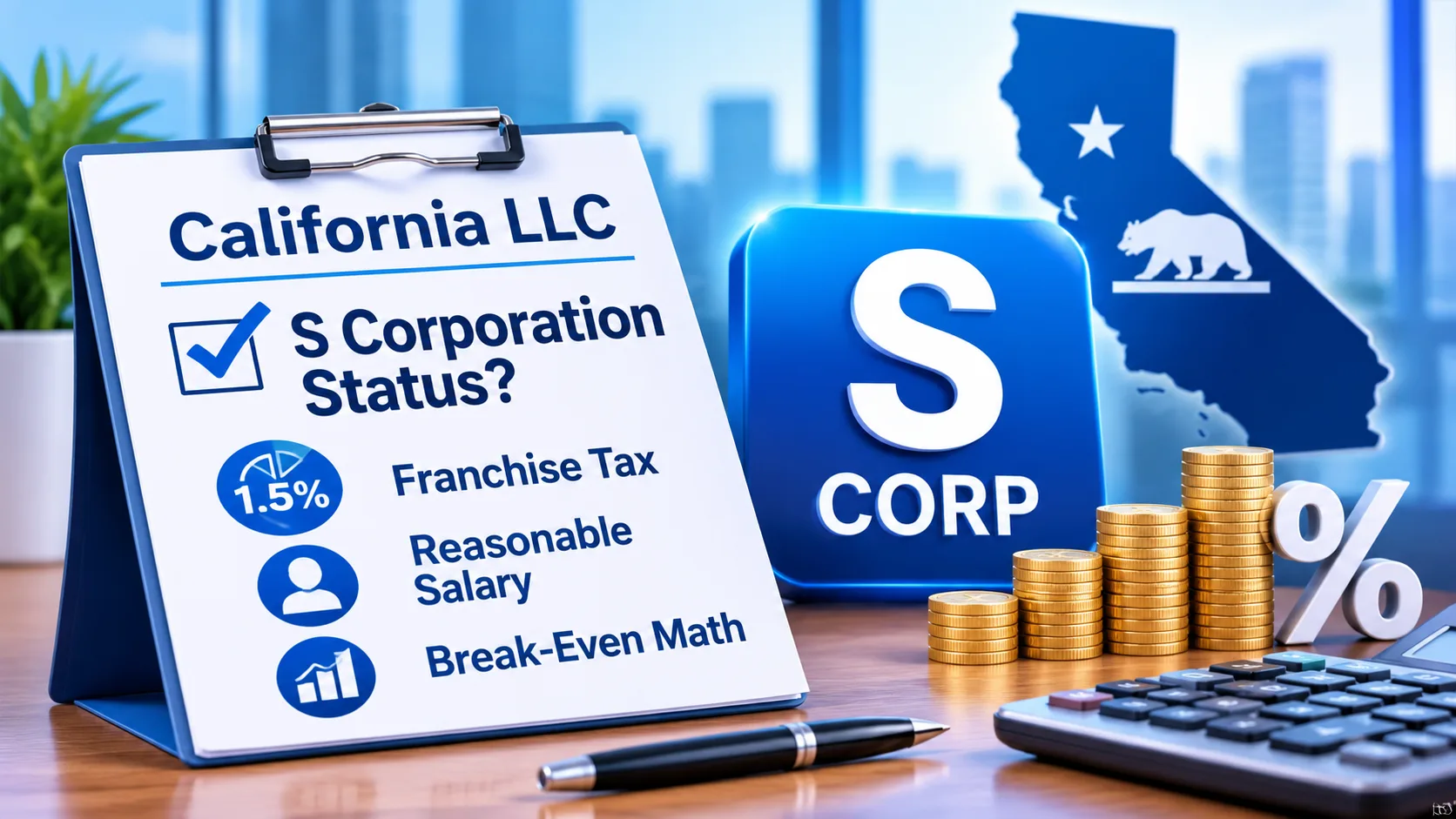
An S corporation election can reduce self-employment tax because owners pay payroll tax only on a reasonable salary, not on distributions. In California, however, S corporations pay a 1.5% franchise tax on net income (minimum $800), and payroll adds cost. The election generally makes sense only once profit comfortably exceeds a reasonable salary plus those added costs.
This guide to the S corp election for a California LLC explains how the election changes federal and California taxation, what it costs in California, how the IRS views reasonable compensation, and how Form 2553 timing works. It includes a break-even comparison. The figures in it are illustrative only and are not a projection of any reader’s results.
Unless it elects otherwise, a single-member LLC is generally taxed as a sole proprietorship, with profit reported on Schedule C, and a multi-member LLC is taxed as a partnership. Owners who work in the business generally pay federal self-employment tax, the self-employed version of Social Security and Medicare tax, on their share of net earnings.
In California, the LLC pays the $800 annual tax and, if its total California income is $250,000 or more, the LLC fee. Our guide to California LLC taxes covers both.
An eligible LLC can elect to be taxed as an S corporation for federal purposes by filing Form 2553. After the election:
California S corporations pay a franchise tax of 1.5% of net income, with a $800 minimum. The S corporation pays the greater of the two, not both. Because the tax is based on net income, it rises as profit grows. (Financial S corporations pay a higher rate.)
Compare that with a default LLC, which pays the $800 annual tax plus an LLC fee only if total California income is $250,000 or more. For a profitable LLC below the fee threshold, the 1.5% tax is a new cost. See the FTB’s guidance on corporations for current rates.
Paying a salary means running payroll, which adds:
The election also adds a separate S corporation tax return, more bookkeeping and payroll reporting, and possibly higher professional fees. Include these costs in any comparison.
S corporation owners who perform services for the business must receive reasonable compensation, meaning pay comparable to what the business would pay someone else for the same work, before taking distributions.
The IRS S corporation compensation guidance lists factors such as:
There is no safe-harbor percentage. Setting salaries too low can lead the IRS to reclassify distributions as wages, with additional taxes, penalties and interest. Setting it too high reduces the benefit of the election. Document how you set the salary, including the comparable pay data and the owner’s role.
The table below uses one simplified, illustrative scenario: a single-owner California LLC with $150,000 of net profit and a $70,000 illustrative salary. It is not a projection of any reader’s results.
| Line | LLC (Sch C) | LLC taxed as S corp |
|---|---|---|
| Net profit | $150,000 (illustrative) | $150,000 before owner salary (illustrative) |
| Reasonable salary | N/A; owner draws are not wages | $70,000 (illustrative) |
| SE/payroll tax | $21,194 self-employment tax (15.3% on 92.35% of profit) | $10,710 Social Security and Medicare on salary (7.65% employer + 7.65% employee) |
| CA 1.5% | N/A | $1,096 (1.5% of $73,050 net income after salary, employer payroll taxes and payroll service) |
| $800 minimum | $800 LLC annual tax; no LLC fee, assuming total California income under $250,000 | Not added; the $800 minimum is already covered because the 1.5% tax exceeds $800 |
| Payroll cost | $0 | $2,505 (illustrative): CA unemployment insurance $238, ETT $7, FUTA about $150, SDI withheld $910, payroll service $1,200 (assumption) |
| Net difference | Total of lines above: $21,994 | Total of lines above: $14,311, or $7,683 lower in this illustration only |
IRS Form 2553 instructions, FTB Form 100S, Social Security wage base.
Want to see how the numbers look for your LLC before the 2027 election deadline? Book an entity review.
At lower profit levels, the added California and payroll costs can outweigh the reduction in self-employment tax. In a second illustrative scenario with $60,000 of profit and a $50,000 salary, the S corporation column comes out roughly $1,400 higher than the LLC column, because the salary absorbs most of the profit and the $800 minimum and payroll costs still apply.
As profit grows relative to a reasonable salary, the potential benefit may grow. But the salary has to be reasonable for the work actually done, and that limits how far the gap can widen.
There is no universal break-even profit. It depends on the reasonable salary for your role, your payroll and compliance costs, and the other factors below.
Making this decision is a planning question, not a filing question. Our guide to tax planning vs. tax preparation explains the difference. If you elect, our guide to California estimated tax payments covers how withholding and estimates work.
Under the Form 2553 instructions, the election must generally be filed no more than 2 months and 15 days after the beginning of the tax year it is to take effect, or at any time during the preceding tax year. For a calendar-year LLC that wants S corporation status for 2027, the deadline is March 15, 2027, and the form can be filed any time in 2026.
An eligible LLC that timely files Form 2553 is generally treated as also electing to be classified as a corporation, so a separate Form 8832 is usually not needed.
If the deadline is missed, the IRS provides relief in certain circumstances. Under the procedure described in the Form 2553 instructions, an entity can generally request relief within 3 years and 75 days of the intended effective date if it has reasonable cause for filing late and meets the other requirements. Relief isn’t automatic, and the requirements should be reviewed before filing.
California generally follows a valid federal S corporation election, with no separate California election form. Once the election is effective, the entity files Form 100S and is subject to the California S corporation franchise tax.
S corporations can have no more than 100 shareholders, generally limited to U.S. citizens or residents, certain trusts and estates, and certain other eligible entities. They can’t have partnerships, corporations or nonresident aliens as shareholders, and they can have only one class of stock. Multi-member LLCs should review their operating agreement, because special allocations can create a second-class-of-stock problem.
Want help reviewing timing and eligibility before you file? Book an entity review.
These are general considerations, not rules:
NexusWorks is led by California-licensed CPAs. Our tax planning and strategy services support entity and planning decisions like this one. A clearly scoped entity review generally follows these steps:
We confirm scope before work begins and can’t promise a particular outcome. If you elect, our tax filing and compliance and bookkeeping services can support the added returns and payroll records.
Use these fields to organize your numbers for a conversation with a CPA. It’s for organizing information, not a final determination.
☐ Expected net profit: ____________
☐ Owner’s role, weekly hours and comparable pay research: ____________
☐ Proposed reasonable salary: ____________
☐ Federal payroll taxes on salary: ____________
☐ California payroll taxes (UI, ETT, SDI): ____________
☐ Payroll service and administrative costs: ____________
☐ California 1.5% franchise tax (or $800 minimum): ____________
☐ Current LLC annual tax and LLC fee: ____________
☐ QBI, retirement plan and PTE notes: ____________
☐ Questions for your CPA: ____________
It depends. An S corporation election can reduce federal self-employment tax, but in California it adds the 1.5% franchise tax, payroll taxes and compliance costs. It generally makes sense only when profit comfortably exceeds a reasonable salary plus those costs, and when you’re ready to run payroll. Model your own numbers first.
California S corporations pay a franchise tax of 1.5% of net income, with an $800 minimum. The S corporation pays whichever is greater, not both. Because the tax is based on net income, it increases as profit grows. Financial S corporations pay a higher rate, set by the FTB.
No, not both. A California S corporation pays the greater of 1.5% of its net income or the $800 minimum. Once 1.5% of net income exceeds $800, which happens above roughly $53,333 of net income, the minimum is already covered. An LLC taxed as an S corporation no longer pays the separate LLC annual tax or LLC fee.
No. S corporation income still flows through to the owner’s California return, whether it’s paid as salary or distributions. California has no self-employment tax, so the payroll-tax benefit is federal only. The election also adds California’s 1.5% franchise tax at the entity level, which the default LLC doesn’t pay.
Reasonable compensation is the salary an S corporation would pay someone else for the owner’s services. The IRS considers training and experience, duties, time devoted, what comparable businesses pay and the company’s compensation and distribution history. There is no safe-harbor percentage, so document how the salary was set.
There is no universal number. The break-even point depends on the reasonable salary for your role, payroll and compliance costs, the 1.5% franchise tax and factors such as the QBI deduction and retirement plans. At modest profit, added costs can outweigh the benefit. Each business needs its own calculation.
Form 2553 is generally due no more than 2 months and 15 days after the start of the tax year the election should take effect, or any time in the preceding year. For a calendar-year LLC wanting S corporation status for 2027, that means by March 15, 2027, or any time during 2026.
The IRS offers late-election relief in certain circumstances. An entity can generally request relief within 3 years and 75 days of the intended effective date if it has reasonable cause and meets the other requirements in the Form 2553 instructions. Relief isn’t automatic, so review the requirements before filing.
An S corporation election is a trade-off. It can reduce federal self-employment tax, but in California it adds the 1.5% franchise tax, payroll costs and more compliance. Whether it fits depends on your profit, a reasonable salary for your role and the other factors that come with it.
Want to see how the numbers look for your LLC before the 2027 election deadline? Book an entity review.
You can also contact NexusWorks to discuss your situation.
Keep reading
Tax Planning Strategies
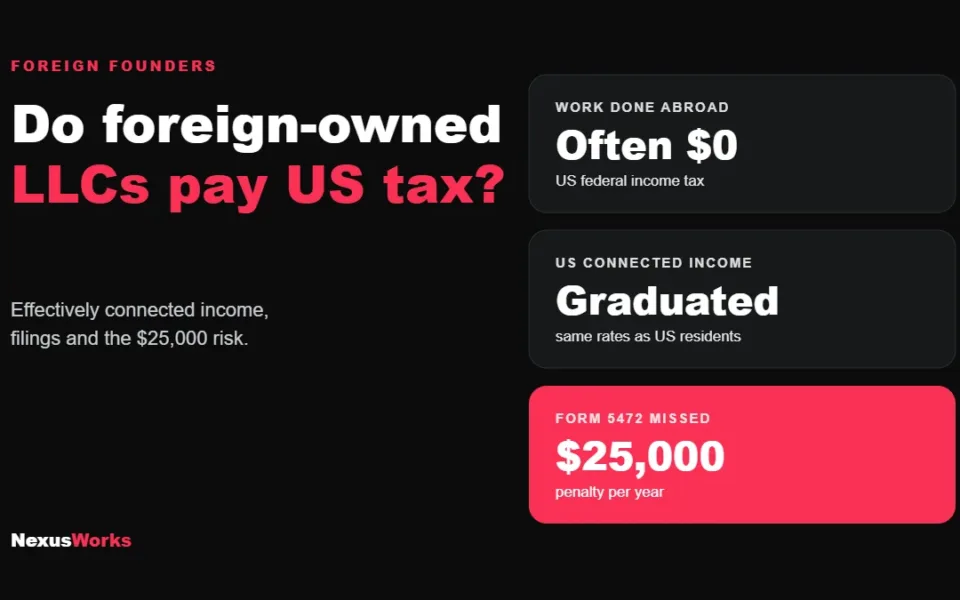
A foreign-owned US LLC pays US income tax only on effectively connected income. Many owe nothing, but still…
READ MORE ●Tax Planning Strategies
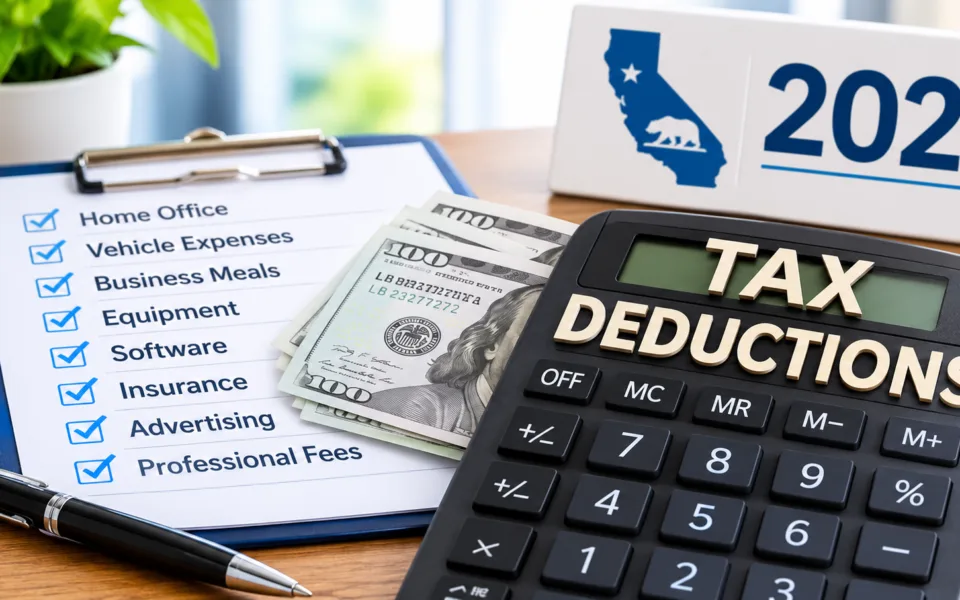
Common small business tax deductions include rent or a home office, vehicle use, equipment, software, insurance, professional fees,…
READ MORE ●Tax Planning Strategies
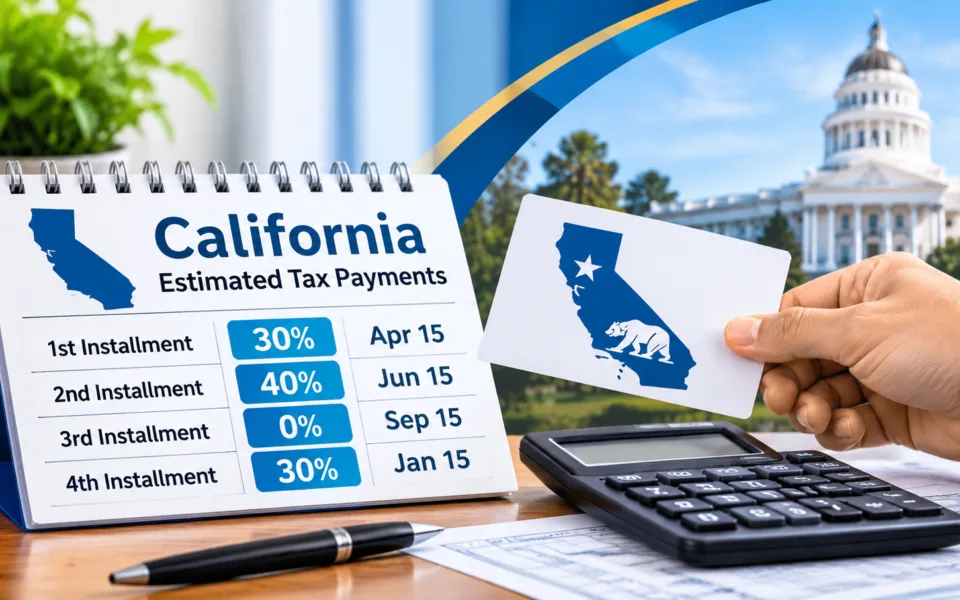
California splits estimated tax into four installments of 30%, 40%, 0% and 30% of the required annual payment.…
READ MORE ●Hi there! Have a question about tax, bookkeeping or CFO support? Send us a message on WhatsApp.
Start chat