Tax Planning Strategies
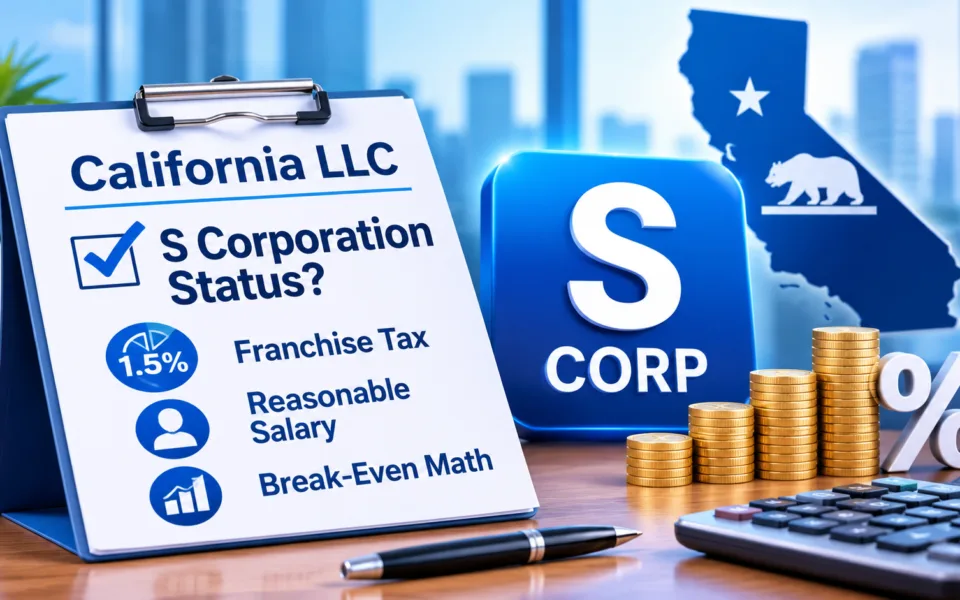
Should Your California LLC Elect S Corp Status? (2026)
An S corporation election can reduce self-employment tax because owners pay payroll tax only on a reasonable salary,…
READ MORE ● NexusWorks Team
Reviewed by a licensed CPA
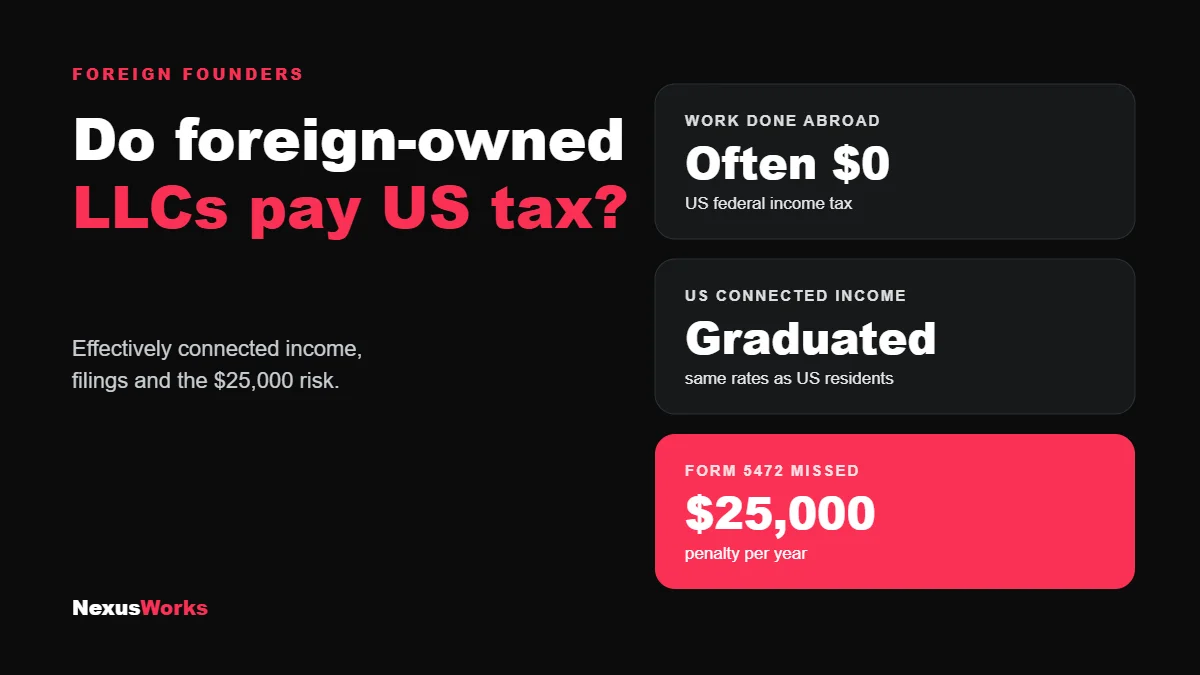
Short answer: A foreign-owned US LLC pays US income tax only on effectively connected income. Many owe nothing, but still must file Form 5472 every year.
Short answer: a foreign-owned US LLC pays US income tax only on income that is effectively connected with a US trade or business. Many single-member LLCs owned by a non-US resident, selling services performed entirely outside the US, owe no US federal income tax at all. They still have to file. A single-member foreign-owned LLC must send Form 5472 with a pro forma Form 1120 every year, and missing it carries a $25,000 penalty.
“No tax” and “nothing to file” are two very different things, and mixing them up is the most expensive mistake foreign founders make. Here’s how to tell which side of the line your LLC is on.
An LLC is a state law entity. For federal tax, the IRS treats it according to how many owners it has and what it elects:
| LLC type | Default federal treatment | Main annual filing |
|---|---|---|
| One foreign owner | Disregarded entity. Income belongs to the owner. | Form 5472 with a pro forma Form 1120, plus Form 1040-NR if the owner has effectively connected income |
| Two or more owners | Partnership | Form 1065, with K-1s, and withholding forms if foreign partners have effectively connected income |
| Any LLC that elects corporate treatment | C corporation | Form 1120, with Form 5472 if a 25% foreign owner exists |
A foreign owner can’t elect S corporation status, because S corporations can’t have nonresident alien shareholders. We compare the LLC and C corporation routes in our guide to US entity structure for foreign owners.
The IRS taxes nonresidents in two buckets. Income that is effectively connected with a US trade or business, called ECI, is taxed after deductions at the same graduated rates US residents pay, according to the IRS page on effectively connected income. Certain passive US source income that isn’t connected to a business, such as some dividends, rents and royalties, is generally taxed at a flat 30% unless a treaty lowers it. IRS Publication 519 covers both.
Owning a US LLC doesn’t by itself create a US trade or business. What matters is where the work happens and who does it.
For services, the place the work is physically done generally decides the source of the income. A designer in Lahore billing a US client through a Wyoming LLC is earning foreign source income. The same designer spending three months working from Austin is not, for those months.
| Founder | Facts | Likely US income tax |
|---|---|---|
| Software consultant in Pakistan | Single-member LLC, all work done abroad, US clients | Usually none. Form 5472 still due every year. |
| Ecommerce seller in the UK | Single-member LLC, products stored in US warehouses | Depends on facts and the US UK treaty. Needs review, and sales tax applies separately. |
| Two partners in the UAE and Canada | Multi-member LLC with a US sales manager | Likely yes on US connected profit, with partnership withholding on the foreign partners’ share |
Treaties can change the result. Many US tax treaties only allow the US to tax business profits that come from a permanent establishment, such as a fixed office. If your country has a treaty with the US, that can protect profit that would otherwise be taxable, but you usually have to claim the treaty position on a return.
A disregarded LLC is invisible for US tax, but your home country may see it differently. Many countries tax their residents on worldwide income, so profit that’s tax-free in the US is often taxable at home. Some treat the LLC as a company, others as a branch. Get advice in your country of residence before you assume the LLC saves tax overall.
Only on income effectively connected with a US trade or business, plus a flat 30% on certain passive US income. A foreign-owned single-member LLC doing all its work outside the US often owes no federal income tax, but it must still file Form 5472 every year.
Yes, in most cases. A single-member LLC owned by a foreign person files Form 5472 with a pro forma Form 1120 every year, even with no income, if there were any transactions with the owner, including paying formation costs.
Not automatically. For services, the source of income is generally where the work is performed. Services performed entirely outside the US are usually foreign source income, even when the client is in the US.
Often yes. Most states charge annual fees or minimum taxes regardless of profit, such as Delaware’s $300 annual LLC tax and California’s $800 annual tax.
Not sure whether your LLC has US taxable income? Our foreign-owned entity team reviews your setup and files what’s required. Book a call to start.
Keep reading
Tax Planning Strategies
An S corporation election can reduce self-employment tax because owners pay payroll tax only on a reasonable salary,…
READ MORE ●Tax Planning Strategies
Common small business tax deductions include rent or a home office, vehicle use, equipment, software, insurance, professional fees,…
READ MORE ●Tax Planning Strategies
California splits estimated tax into four installments of 30%, 40%, 0% and 30% of the required annual payment.…
READ MORE ●Hi there! Have a question about tax, bookkeeping or CFO support? Send us a message on WhatsApp.
Start chat