Tax Planning Strategies
Best State to Form an LLC as a Non-US Resident
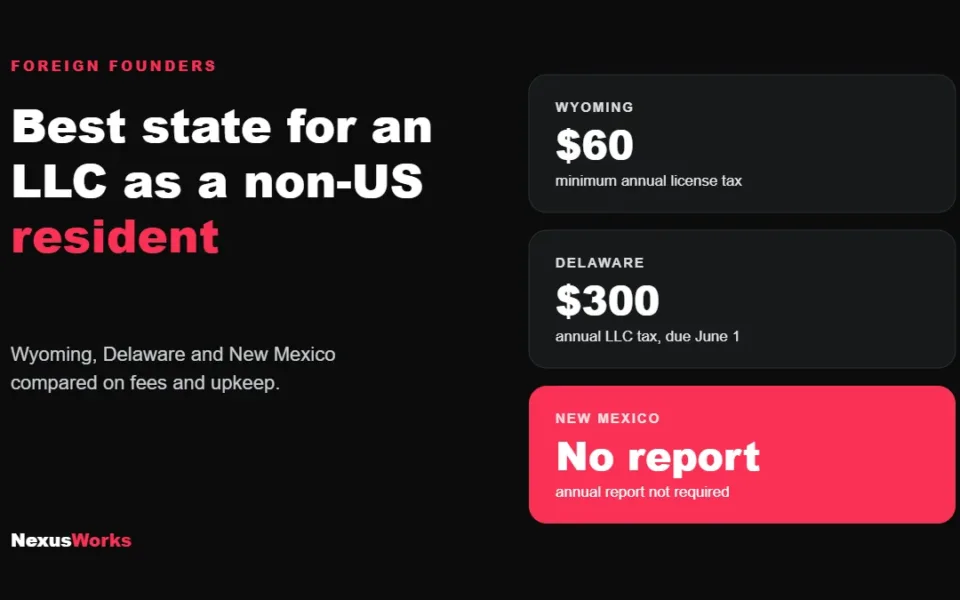
Wyoming is usually the best state for a non-US founder running an online business from abroad. Compare Wyoming,…
READ MORE ● NexusWorks Team
Reviewed by a licensed CPA
Short answer: Delaware's notice uses the Authorized Shares method, which can show $85,165 for a startup with 10 million shares. Recalculated with the Assumed Par Value Capital method, most early-stage C corporations pay the $400 minimum plus a $50 filing fee, due March 1.
Every year in late February, we get the same message from a founder somewhere outside the US: “Delaware says I owe $85,165 in franchise tax. Is this real?” It almost never is. The number is real on the notice, but it comes from the default calculation method, and a startup with ordinary paperwork usually ends up paying $400 plus a $50 filing fee once the return is redone with the other method.
Below, we’ll show you how Delaware franchise tax works for a C corporation, why that first number looks so wild, and which dates catch out founders who live abroad. You’ll need two numbers from your own records. We’ll tell you which.
If you formed a corporation in Delaware, you file an Annual Franchise Tax Report and pay franchise tax every year. It doesn’t matter whether you’ve made a sale yet, or whether you’ve ever set foot in the US. Delaware LLCs work differently. They don’t file the report and instead pay a flat $400 annual tax, due June 1.
Where you live doesn’t change the Delaware bill. It changes the federal paperwork that sits next to it. We’ll get to that.
Delaware lets a corporation pay the lower of two methods, according to the Division of Corporations’ own calculation guide.
| Authorized Shares method | Assumed Par Value Capital method | |
|---|---|---|
| Based on | How many shares the charter authorizes | Gross assets, issued shares and par value |
| Minimum tax | $175 | $400 |
| Maximum tax | $200,000 | $200,000 |
| Who it suits | Companies with very few authorized shares | Most venture-style startups with millions of authorized shares |
Here’s the catch. The notice Delaware sends you uses the Authorized Shares method. Under it, a company with up to 5,000 authorized shares pays $175, a company with 5,001 to 10,000 pays $250, and every extra 10,000 shares adds $85.
Startup lawyers commonly authorize 10,000,000 shares at a par value of $0.00001. Under the Authorized Shares method, that’s $250 for the first 10,000 shares plus 999 more blocks of 10,000 at $85 each, which comes to $85,165.
Now run the same company through the Assumed Par Value Capital method. Say it has $50,000 in total gross assets at year end and 8,000,000 shares issued.
Add the $50 Annual Report filing fee and you’re paying $450, not $85,165. That’s it. Delaware’s online system recalculates once you enter issued shares and gross assets, so your only job is getting those two numbers right.
Where does the gross assets figure come from? Delaware asks for total assets as reported on Schedule L of the company’s federal Form 1120. That’s one reason a foreign-owned C corporation needs real year-end books, not a guess.
| What | Due | If late |
|---|---|---|
| Annual Franchise Tax Report and tax (corporations) | March 1 | $200 penalty plus 1.5% interest per month on unpaid tax |
| Estimated payments (if you owe $5,000 or more) | 40% by June 1, 20% by September 1, 20% by December 1, rest by March 1 | 1.5% interest per month on any unpaid tax |
| Annual tax (Delaware LLCs) | June 1 | $200 penalty plus 1.5% interest per month |
| Federal Form 1120 (calendar year corporation) | April 15, or October 15 with Form 7004 | IRS late-filing penalties |
Delaware sends the franchise tax notice to your registered agent in December. If your agent forwards mail to an inbox nobody checks, you’ve got a problem. That’s how a $450 bill turns into a penalty, and then into a company that’s no longer in good standing. The source for these dates is the Delaware Annual Report and Tax Information page.
If you, or any foreign shareholder, own 25% or more of a Delaware C corporation, there’s a federal layer on top of the state one:
We cover the wider picture in our article on Delaware C-corp tax compliance for foreign founders, and the LLC versus corporation decision in US entity structure for foreign owners.
Delaware’s notice uses the Authorized Shares method, which charges by the number of shares in your charter. Startups with millions of authorized shares usually pay far less under the Assumed Par Value Capital method, often the $400 minimum.
March 1 every year for corporations, together with the Annual Franchise Tax Report. Delaware LLCs pay a flat $400 by June 1 instead.
Delaware charges a $200 penalty for a late Annual Report and 1.5% interest per month on unpaid tax. Leaving it unpaid can cost the company its good standing.
No. The Delaware calculation is the same wherever the founders live. Foreign ownership adds federal filings instead, mainly Form 1120 with Form 5472.
Not sure which number to pay? Book a short call and send us your cap table and year-end balance sheet. We’ll check the calculation before you file.
Keep reading
Tax Planning Strategies
Wyoming is usually the best state for a non-US founder running an online business from abroad. Compare Wyoming,…
READ MORE ●Tax Planning Strategies
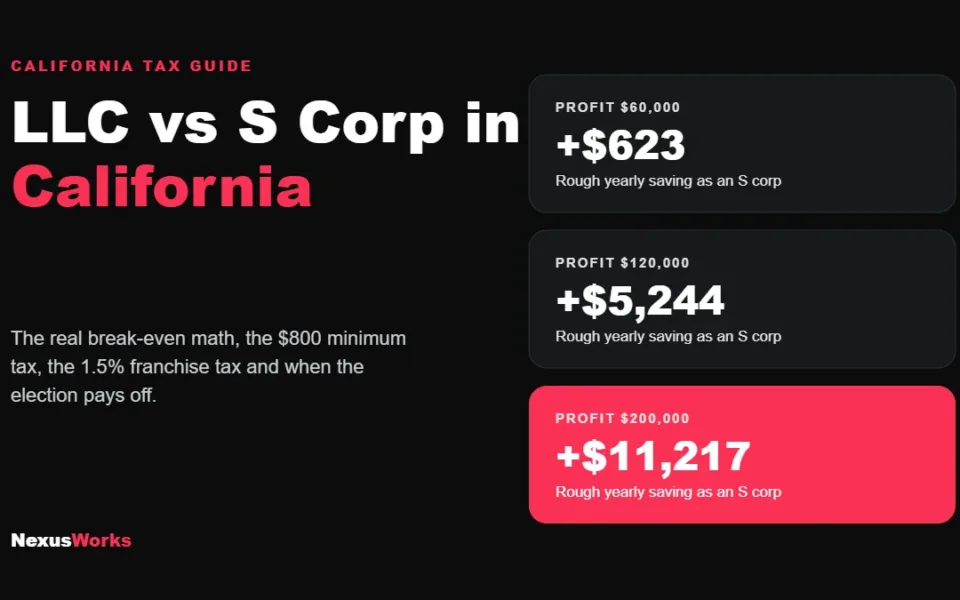
An LLC taxed as an S corp in California usually pays off once profit passes about $80,000 to…
READ MORE ●Tax Planning Strategies
Compare fractional CFO vs. full-time CFO costs, responsibilities and benefits. Learn when each option makes financial sense for…
READ MORE ●Hi there! Have a question about tax, bookkeeping or CFO support? Send us a message on WhatsApp.
Start chat