
Business
QuickBooks Payroll Setup Checklist
Before the first QuickBooks payroll, open your state withholding and unemployment accounts, collect W-4s and state forms, set…
READ MORE ● NexusWorks Team
Reviewed by a licensed CPA
Short answer: A small business usually spends $3,800 to $11,000 a year on a CPA once bookkeeping, returns and planning are included. See costs by stage.
Short answer: a small business usually spends somewhere between $3,800 and $11,000 a year on a CPA once bookkeeping, the business tax return, the owner’s return and some tax planning are included. A solo business on Schedule C sits at the low end. A profitable S corporation with payroll and two owners sits near the top. Tax preparation alone is a smaller number, but it’s rarely what a growing business actually needs.
Most pricing articles only quote the cost of one tax return. That’s the wrong number to budget around. This guide shows what a full year with a CPA costs at three stages of a business, using our own published fees, and what pushes a quote up or down.
A CPA relationship for a small business usually covers four jobs. You may not need all four on day one, but you’ll pay for each of them sooner or later:
If you only want the return prepared, our article on CPA tax preparation costs in California covers return fees on their own. This article is about the whole year.
| Business stage | What’s included | Annual cost at NexusWorks |
|---|---|---|
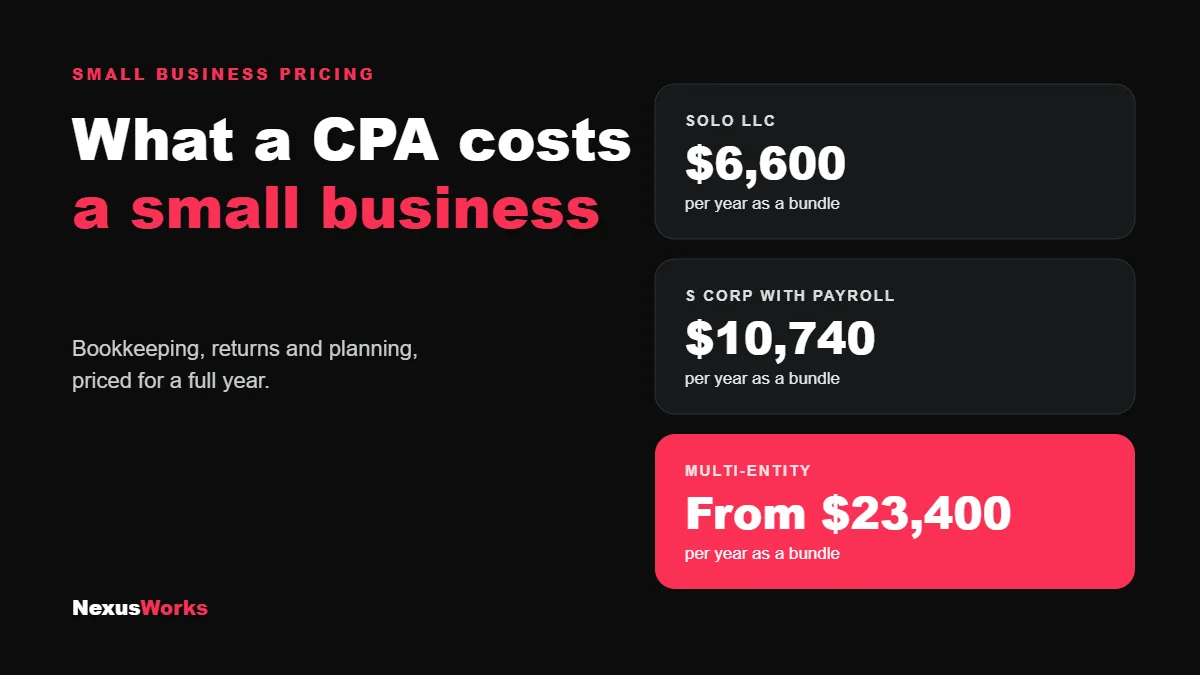
| Solo owner, single-member LLC, under $50,000 in monthly expenses | Monthly bookkeeping, Schedule C return with the owner’s 1040, quarterly estimates | About $6,600 as a bundle ($550 a month) |
| Profitable S corp or partnership with payroll | Bookkeeping with payroll entries, 1120-S or 1065, up to two owner returns, quarterly planning and an annual entity review | About $10,740 as a bundle ($895 a month) |
| Several entities, inventory or multiple states | Accrual books, consolidations, every entity and owner return, monthly CFO call | From about $23,400 ($1,950 a month and up) |
You can also buy the pieces separately. A very simple setup, with Starter bookkeeping at $199 a month, a Schedule C return from $450 and quarterly planning at $250 a quarter, comes to roughly $3,840 a year. The bundle costs more but adds notice handling, a year-end review and a single team that knows your numbers. Every starting fee is listed on our pricing page.
Two businesses with the same revenue can get very different quotes. These are the things that actually move the price:
Most small business CPAs now charge fixed monthly fees rather than hourly rates. The reason is simple: a monthly fee tells you the cost in advance, and it means you won’t hesitate to send a quick question because the clock is running. We price on volume and complexity, not hours. Hourly billing still makes sense for one-off work such as a cleanup or a complex IRS matter, where nobody can know the scope up front.
Whatever the model, ask what isn’t included. The common extras are prior-year catch-up, extra states, IRS representation, sales tax filings and financial statements for a lender.
A CPA pays for themselves in three ways. The first is planning. An S corp election, a retirement plan or the California PTE tax can each save more in one year than a year of fees, as our breakdown of LLC vs S corp in California shows. The second is avoided penalties. One missed payroll filing or a late Form 5472 can cost more than the whole engagement. The third is time. Most owners spend far more hours on their own books than they realize.
It’s probably not worth it yet if you have one income stream, no employees, under a few hundred transactions a year and no plans to change your structure. In that case a single return each spring may be enough.
A monthly retainer that covers bookkeeping, tax returns and planning typically runs about $550 to $900 a month for a small business, and more for multi-entity or multi-state companies. Bookkeeping alone can start around $199 a month.
At NexusWorks, a Schedule C return with the owner’s 1040 starts from $450, and an S corporation or partnership return starts from $650. Complex returns are quoted after review.
Not in direct cost, but often in total cost. Missed deductions, the wrong entity structure and late filing penalties regularly cost more than a year of CPA fees.
Some do, but most small business CPAs now use fixed monthly fees. Hourly billing is more common for cleanup projects and IRS resolution work.
Want an exact number for your business? Book a 15-minute call and we’ll quote your year before you commit to anything.
Keep reading
Business
Before the first QuickBooks payroll, open your state withholding and unemployment accounts, collect W-4s and state forms, set…
READ MORE ●Business
How white-label bookkeeping works for CPA firms, what it costs, and the Section 7216 and data security rules…
READ MORE ●Business
Get the exact wording from whoever is asking, then go to the CPA who prepares your returns with…
READ MORE ●Hi there! Have a question about tax, bookkeeping or CFO support? Send us a message on WhatsApp.
Start chat